The post Unlocking Business Insights: How Audits Can Reveal Hidden Opportunities appeared first on AGN International.
]]>The term “audit” for many businesses brings to mind regulatory scrutiny, along with compliance requirements and administrative challenges. However, this view misses a crucial point. A properly conducted audit represents more than a mere regulatory requirement because it serves as a strategic instrument that reveals operational weaknesses while enhancing control systems and detecting potential areas for business expansion.
Audits become effective tools for business enhancement when conducted by knowledgeable professionals with a clear purpose, as they reveal both operational and financial aspects, which lead to better performance and sustained success.
Beyond Compliance: The True Value of an Audit
Audits are primarily driven by financial reporting obligations and regulatory standards, yet they consistently yield numerous hidden insights during the process. Through independent and objective assessment, an exhaustive audit evaluates a company’s financial condition as well as its control systems and operational integrity. An external viewpoint helps to identify operational trends and risks alongside hidden inefficiencies that normal operations fail to detect.
Some of the critical benefits include:
- Identifying inefficiencies in operations or cash flow.
- The audit identifies areas where control systems show weaknesses or inconsistent application.
- Assessing both the correctness of financial information and the trustworthiness of data used for making business decisions.
- Detecting unrecognised risks or liabilities.
- Revealing underperforming business units or unprofitable products.
- Finding potential tax and compliance problems before they develop into bigger issues.
Businesses that engage with audit processes move beyond compliance to establish stronger positions for strategic decision-making and resource optimisation while planning growth.
Calibre Business Advisory’s Role in Adding Value
Growing businesses with limited internal staff or disjointed financial structures often find the audit process challenging to navigate. Calibre Business Advisory can assist businesses during this stage of the process. Organisations work with Calibre to transform their audit outlook from a burdensome necessity into a strategic advantage through our deep expertise in audit preparation and advisory services.
Their approach involves:
1. Pre-Audit Readiness and Risk Assessment
Calibre collaborates with clients to evaluate financial records and risk exposures as well as internal control status before starting the audit process. The process promotes efficient auditing alongside early detection of warning signs.
2. Liaising With External Auditors
We function as a connecting point between the business and external auditors while managing documentation completeness and response accuracy, and explaining potential issues. The process enhances engagement while minimising unexpected risks.
3. Translating Audit Findings Into Strategic Insights
Calibre provides advisory services immediately after the conclusion of many audit reports. Our experts translate audit findings into business strategies by pinpointing internal inefficiencies, procedural gaps, and financial inconsistencies that need resolution.
4. Embedding Continuous Improvement
Calibre inspires clients to move beyond the perception of audits as annual activities by fostering a year-round culture of continuous improvement using audit insights to boost operational performance, compliance standards and strategic growth planning.
Case in Point: Operational Efficiency
Audits often reveal critical insights about operational inefficiencies, which hold significant value. Operational inefficiencies can appear as poor inventory management systems alongside ineffective procurement procedures and repeated administrative operations with insufficient cost tracking methods. Businesses that discover inefficiencies can create better processes which help cut waste, increase profit margins and use resources more efficiently.
Calibre’s team provides clients with customised action plans to execute audit recommendations, which include tasks such as software integration, workflow restructuring and staff retraining. Businesses achieve better audit compliance along with improved business agility and cost savings.
Strengthening Internal Controls and Governance
The implementation of robust internal controls plays a key role in reducing fraud risk while guaranteeing data integrity and sustaining stakeholder trust. The audit process consistently identifies system weaknesses, including insufficient separation of duties, together with undocumented policies and unrestricted access to financial information.
Businesses can establish risk-based control frameworks matched to their organisation’s size and complexity through collaboration with Calibre Business Advisory. Control frameworks can involve automated approval workflows as well as delegated authority matrices, together with enhanced reporting tools. Better governance helps organisations succeed in audits while also establishing long-term stability and building investor trust.
Leveraging Financial Insights for Strategic Growth
Financial audit results expose underlying trends, including weak business segments and irregular revenue patterns alongside unnecessary spending areas. These insights act as a foundational platform to develop strategic plans.
For example, a business might:
- Streamline product offerings based on margin analysis.
- Adjust pricing strategies to improve profitability.
- Divest underperforming assets.
- Reinvest in high-growth areas.
Businesses that utilise these insights together with professional advice from business advisors can achieve decisions that maintain financial stability and capitalise on market opportunities.
Aligning with Evolving Regulatory Expectations
The regulatory sector has recently placed greater emphasis on ESG (environmental, social, and governance) disclosures, cyber risk mitigation, and corporate transparency standards. Modern audits now cover expanded areas, which makes remaining proactive crucial for businesses.
Sydney-based audit firms, including Calibre’s partners, maintain up-to-date knowledge of current reporting standards and industry expectations. Businesses that maintain compliance while demonstrating proactive governance build a stronger reputation that attracts stakeholders, customers and investors.
Embedding a Culture of Continuous Review
A shift in mindset represents the most powerful legacy that results from a high-impact audit. Companies that approach audits simply as compliance exercises fail to realise opportunities for ongoing enhancement. Organisations that adopt the review and reflection process as part of their operations obtain a strategic advantage.
Audits as a Catalyst for Growth
An effective audit process has the power to act as a transformative force within businesses rather than being just a formality. Audits empower organisations to eliminate hidden weaknesses and financial misunderstandings while directing them toward operational an improvement, which enables them to solidify their core structure and capitalise on growth possibilities.
Businesses achieve maximum audit benefits when they partner with established professionals from organisations like Calibre Business Advisory. Audits transform from mere compliance tasks into vital instruments for sustained success through custom support and strategic execution.
Audit services in Sydney are a wise investment for businesses that want to access these growth opportunities. Organisations that combine curiosity with thorough preparation and a dedication to continual betterment during audits can improve their performance while establishing trust and succeeding in complex global environments.
Contributed by:

Calibre Business Advisory
Level 8, 1 York St Sydney NSW 200
Web: https://calibreba.com.au/
Email: enquiries@calibreba.com.au
Phone: +61 2 9261 2177
The post Unlocking Business Insights: How Audits Can Reveal Hidden Opportunities appeared first on AGN International.
]]>The post Chaordic CFO – Managing DISTRESS in an Uncertain Future appeared first on AGN International.
]]>Chaordic perfectly describes the environment finance leaders now operate in, a fusion of chaos and order. In March 2025, R Venkatakrishnan wrote an article titled Accounting in the Era of STEM, published in The Hindu Business Line. The piece explored the changing landscape of the finance profession amidst the rise of Science, Technology, Engineering, and Mathematics disciplines. The response was overwhelming and encouraging. It prompted a deeper reflection—not just on accounting per se, but on the evolving nature of leadership in finance, particularly the CFO’s role.
That journey, and the conversations it sparked, culminated in an address to a forum of senior finance professionals on the theme: “Chaordic CFO – Managing DISTRESS in an Uncertain Future.” The title was a deliberate play, on both the emotional and structural stress, experienced in today’s business world, and on the leadership compass needed to manage it.
The word Distress:
Was used as a strategic acronym Disruption, Innovation, Strategy, Transformational Growth, Resilience, Execution, Storytelling, and Stakeholder Management. Each dimension reflects an area where the CFO’s responsibilities have evolved. The objective is not merely to diagnose corporate pain points, but to offer a roadmap moving from distress to ‘eustress’ a productive, purposeful stress that drives excellence.
The term ‘chaordic’:
Perfectly describes the environment finance leaders now operate in, a fusion of chaos and order. Today’s CFO must strike a balance between structure and innovation, compliance and creativity. Systems must be self-organising, adaptive, and resilient. Too much order leads to rigidity and missed opportunities. Too much chaos results in collapse and confusion. The Chaordic CFO thrives in this space, designing systems that are stable yet agile prepared for disruption, but wired for reinvention. Chaordic is not about eliminating uncertainty it is about leveraging it for growth.
Chaordic: Setting the Stage
In a world of exponential change technological acceleration, regulatory flux, ESG expectations, and geopolitical uncertainty—finance professionals are under more pressure than ever. For decades, they have been trained to drive by looking in the rear-view mirror, obsessing over historical data. But in today’s landscape, that’s not just limiting it is dangerous.
Marshall Goldsmith’s famous book, ‘What Got You Here Won’t Get You There’, speaks to a mindset shift. Past strengths become blind spots. Comfort zones calcify. To lead in the modern enterprise, CFOs must let go of outdated patterns and embrace agility. The real question is not whether change is coming it is whether we are ready to stay ahead of it.
Disruption: The New Normal
Disruption is not a trend in this environment. Technology is reshaping every sector, consumer behaviour is shifting faster than ever, and geopolitical shocks are redefining supply chains. What makes this disruption more challenging is its unpredictability and pace. CFOs must now function as foresight enablers detecting early signals, modelling scenarios, and funding agility.
It is deeply ironic that the quote ‘Only the paranoid survive’ came from Andy Grove, the former CEO of Intel a company now facing sustained challenges from Nvidia and Chinese semiconductor firms. Even titans can stumble if they fail to adapt. Disruption now comes not just from competitors but from adjacent industries, startups, and platform models. CFOs must build organisations that don’t just absorb shocks but anticipate and capitalise on them.
Innovation: Commercialising the Future
Innovation has shifted from being a lab function to a boardroom priority. It is also conjunction of two words viz., invention and commercialisation. It’s no longer just about products; it is about new business models, new partnerships, and new ways of delivering value. CFOs must move beyond the ROI lens alone and understand the potential of test-and-learn models, venture capital style investments, and sandbox experimentation.
Take 3M’s example, where 40% of its revenues must come from products introduced in the last five years. Or Ather Energy, incubated by IIT Madras, that scaled into a nationally recognised EV brand where the incubator has raked in a coolk Rs.50 crore from the offer for sale in the public issue. Finance must now fuel innovation not just evaluate it. CFOs must underwrite risk that creates long-term optionality.
Strategy: Agility with Focus
Strategic clarity is no longer about five-year forecasts. It’s about adaptive decision-making and dynamic capital allocation. AV Thomas’s investment of ₹25 crore in Chai Kings shows how legacy firms are diversifying into emerging markets a classic case of corporate venture capital. Similarly, Century Pulp’s divestiture of its paper division to ITC for ₹3500 crore underlines the strategic importance of focusing on core competencies.
Organisations are embracing circularity to reduce waste and manage cost, aligning sustainability with strategy. According to an EY India survey, over 74% of Indian corporates plan to divest non-core assets over the next 24 months. CFOs must be stewards of simplification and strategic boldness.
Transformational Growth: Moving Beyond Linear Ambitions
Linear growth is no longer viable. In a post-pandemic economy shaped by digital transformation, CFOs
must support adjacencies, build ecosystems, and simultaneously drive scale and efficiency. Transformational growth is about doing many things at once; entering new markets, exiting declining
verticals, building platforms, and reinventing delivery.
It also involves challenging assumptions. The boldest CFOs support disruptive bets whether transitioning from B2B to B2C, investing in net zero transitions, or acquiring capabilities, not just revenue. Transformational CFOs help the organisation operate with a venture capitalist mindset.
Resilience: The Boardroom Priority
Resilience is no longer reactive; it must be embedded in business design. From climate events to cyberattacks and supply disruptions, organisations must be equipped to bounce forward, not just back. McKinsey outlines six dimensions of resilience – financial, operational, technological, organisational, reputational, and business model. CFOs now oversee more than capital; they govern continuity.
Boards now ask: Do we have the liquidity buffer for the next disruption? Can our cost structure flex if demand collapses? Resilience also includes reputational equity. CFOs must institutionalise preparedness, monitor lead indicators, and embed risk thinking into every process.
Execution: The Discipline of Doing
Execution is what separates vision from reality. A recent Business Standard report noted Tata Steel’s plan to take out ₹11,000 crore in costs on top of ₹6000 crore already realised in FY25. Such initiatives signal that execution must be relentless. Consumers are price sensitive. Passing cost increases is difficult. The only path forward is variable cost design, continuous upskilling, and capacity flexibility. Execution also means systems that support decision-making at speed.
The CFO must empower frontline managers with real-time data, nurture a culture of ownership, and facilitate productivity through technology. Agility is not about chaos it is about preparation meeting opportunity.
Storytelling: Data with a Heartbeat
Today’s CFO must speak the language of influence, not just accuracy. Whether explaining investment strategy to the board or decoding ESG disclosures to investors, the ability to narrate numbers is a superpower.
Storytelling brings structure to ambiguity and converts insight into alignment. It is not enough to report that margins shrank. One must explain why, what’s next, and how strategy adapts. Storytelling is also critical in earnings calls, sustainability reporting, and employee town halls. A CFO who can tell a story backed by data earns credibility across all stakeholders.
Stakeholder Management: The Trust Imperative
Stakeholder management has become central to the CFO’s role. With rising public scrutiny, social media activism, and ESG mandates, companies must engage diverse interest groups with integrity. Stakeholders now include investors, employees, regulators, communities, NGOs, and platforms. Each has different expectations—and one misstep can go viral.
CFOs must ensure that communication is consistent, transparent, and backed by ethics. From regulatory filings to advertising messages, every output must reinforce corporate trustworthiness. In this era, compliance is the baseline. What sets leaders apart is principled engagement.
From DISTRESS to EUSTRESS
Not all stress is harmful. Eustress, the positive tension that motivates performance, is essential to growth. The Chaordic CFOs doesn’t fear challenge. They harness it. They convert disruption into discipline, ambiguity into architecture, and pressure into possibility.
Moving from DISTRESS to EUSTRESS is about re-framing the CFO’s function: from protector to co-creator, from controller to catalyst. It is about building cultures that don’t avoid risk but learn from it. Eustress is energy with direction. It empowers the organisation to stretch without snapping.
Inventing the Future
As Alan Kay said, ‘The best way to predict the future is to invent it.’ CFOs now have the mandate and tools to shape the future. But as John C. Maxwell reminds us, ‘If you don’t create the future you want, you must endure the future you get.’
The Chaordic CFO is no longer confined to the balance sheet. They are strategic designers, resilience champions, and change agents. Their mandate is to build organisations that are future-ready fiscally sound, digitally intelligent, and ethically grounded.
This is not just about navigating the next disruption it is about leading the transformation. From DISTRESS to EUSTRESS is not just a framework. It is a call to action.
Contributed by:

R V K S and Associates
Head Office:
No.147, Rajparis Trimeni Towers
GN Chetty Road, TNagar
Chennai, 600017
Branches:
- Chennai
- Banglore
- Hyderabad
- Andhra Pradesh
- Maharashtra
Web: www.rvkassociates.com
Email: assurance@rvkassociates.com
Phone: 044-28150540/541/542
The post Chaordic CFO – Managing DISTRESS in an Uncertain Future appeared first on AGN International.
]]>The post Resilience Strategies for Businesses – Navigate Economic Uncertainty appeared first on AGN International.
]]>Businesses operating within a global economy full of unpredictability need to develop capabilities that help them not just endure economic recessions but also emerge from them with enhanced strength and a competitive edge.
Economic uncertainty stemming from market changes, geopolitical issues or unexpected global phenomena such as pandemics forces businesses to reassess their operational approaches and growth strategies. Organisations must prioritise resilience-building because it has become essential for their survival.
1. Strengthen Financial Planning and Risk Management
Financial resilience starts with rigorous planning. Businesses need to perform stress tests on financial forecasts while keeping ample cash reserves and establishing various financial scenarios for revenue streams and capital requirements. Companies with thorough knowledge of their cash flow patterns that establish backup plans achieve superior decision-making capabilities during unstable times.
Budget flexibility is essential. Instead of fixed yearly plans, organisations should utilise rolling forecasts, which are modified based on current conditions. Evaluate non-essential spending while directing investments towards activities that sustain primary income sources and encourage long-term business expansion.
Consulting business advisory professionals offers valuable supplementary perspectives. Through expert advice, businesses can establish risk-adjusted financial plans while examining debt responsibilities and pinpointing potential financial weaknesses before reaching crisis levels.
2. Diversify Revenue Streams
Businesses that depend entirely on one product or customer group increase their risk in economic recessions. Spreading risk across multiple ventures enables businesses to capture new growth opportunities through diversification.
Businesses need to evaluate their current product or service selections to identify opportunities for adding complementary offerings. A business that delivers services in person could expand its market reach by adopting digital delivery methods.
Businesses can lower their reliance on a single economic region or sector through the feasible exploration of new customer segments and international markets. Stabilising revenue through small diversification efforts does not require major alterations.
3. Increase Operational Flexibility
Businesses need to maintain operational flexibility to scale their operations either up or down swiftly when facing economic uncertainty. The strategy affects all operational areas, including staffing solutions and supply chain management, and extends to production capabilities and distribution methods.
Businesses can benefit from adopting flexible employment models, which include casual contracts and outsourcing of non-essential tasks. Developing strong supplier partnerships helps businesses achieve more responsive inventory control and better cost management.
Companies must prioritise digital transformation investments to progress effectively. Through the implementation of cloud systems and remote work solutions alongside automated procedures, organisations can achieve faster responses and lower fixed expenses but still keep continuous operations.
Periodic evaluations of operational workflows reveal inefficiencies and redundant processes that transform into liabilities during economic downturns. Streamlining business operations boosts day-to-day performance and helps protect the company during economic downturns.
4. Maintain Strong Communication and Leadership
Organisations gain internal and external stakeholder confidence when leadership demonstrates transparency and decisiveness. In periods of uncertainty, leaders need to establish consistent communication with their employees as well as customers, suppliers and investors.
Effective communication regarding business targets and financial status, alongside strategic shifts, promotes trust and alignment. When employees comprehend how their work supports their organisation’s sustainability and recovery, they demonstrate higher engagement and productivity levels.
The participation of essential staff members in contingency preparations and scenario analysis is a fundamental requirement. When employees from various departments work together, they discover useful insights and develop joint responsibility for resilience measures.
5. Optimise Tax Strategy and Compliance
Effective tax planning during economic stress delivers significant savings while boosting cash flow for businesses. Companies need to regularly evaluate their tax responsibilities while checking for possible reliefs, deductions and deferral opportunities, particularly when government stimulus periods or downturn-related concessions are available.
Businesses can achieve compliance and maximise benefits by engaging experienced tax accountants in Sydney. Tax professionals provide guidance on business entity restructuring as well as review capital purchases and superannuation contribution planning to reduce tax liabilities.
Keeping abreast of changing tax laws and regulatory requirements helps prevent expensive penalties and lost opportunities, which become crucial when legislative changes occur rapidly.
6. Embrace Market Adaptability
The power to adapt represents one of the most significant characteristics of businesses that endure. Economic signals and consumer behaviour changes, along with technological breakthroughs, can cause markets to change direction swiftly. Businesses should develop the capability to pivot quickly to address market changes directly.
Perform regular market research to stay informed about industry trends together with competitor actions and customer preferences. Apply this data to improve your value proposition or modify your pricing strategies and consider rebranding as needed.
Customers usually reconsider how they spend their money when economic conditions are unstable. Companies that respond to customer needs with flexible payment options and customised products or services maintain stronger customer loyalty.
7. Invest in Customer and Supplier Relationships
Strong and supportive associations with customers and suppliers become essential lifelines during tough times.
With customers, go beyond transactional interactions. Understand their evolving needs and pain points. Use value-added services and flexible payment options, along with loyalty programs, to maintain customer engagement.
Effective supplier relationships require transparent operations along with proactive communication. Building solid partnerships with suppliers results in advantageous contract terms and inventory access benefits, as well as cooperative problem-solving during difficult times.
When economic conditions require compromise, better long-term results emerge from collaborative partnerships instead of adversarial negotiations.
8. Leverage Data and Scenario Planning
To effectively manage economic changes, businesses require a comprehensive understanding of key performance indicators (KPIs) along with access to real-time data. Reliable data systems deliver improved forecasting capabilities alongside performance monitoring and help uncover cost-saving possibilities.
Scenario planning is equally critical. Build best-case, base-case and worst-case scenarios to understand potential market changes that could affect your business. When preparing for economic changes, ensure to analyse variables like currency fluctuations along with supply disruptions and regulatory shifts and changes in consumer behaviour.
Our objective should be centred around preparing for future events instead of attempting to predict them. Leadership teams that utilise data-driven insights make decisions that have stronger outcomes and lower associated risks.
Calibre Business Advisory is here to help businesses build their operations on solid financial planning and operational adaptability, as well as to transform uncertain situations into business opportunities. No single method ensures protection from external disruptions, but Calibre can develop a comprehensive strategy to increase your company’s capacity to survive difficulties and prepare it for successful recovery.
Businesses gain strategic clarity through external perspectives when they engage expert partners like Calibre at critical times. When strong internal leadership joins forces with continuous improvement practices, businesses establish a foundation that supports true resilience.
Contributed by:
Calibre Business Advisory
Level 8
1 York Street
SYDNEY NSW 2000
AUSTRALIA
Web: https://calibreba.com.au/
Email: tim.sury@calibreba.com.au
Phone: +61 2 9261 2177
The post Resilience Strategies for Businesses – Navigate Economic Uncertainty appeared first on AGN International.
]]>The post Why Should Accounting Be Considered a STEM Discipline? appeared first on AGN International.
]]>Recognising accounting as a STEM (Science, Technology, Engineering, and Mathematics) field not only enhances financial literacy among innovators but also instils sense of accountability, essential for sustainable growth.
In a rapidly evolving business landscape, there is a strong case for integration of accounting into STEM disciplines which is also gaining momentum globally. This shift is particularly pertinent for India, where a burgeoning focus on STEM-driven entrepreneurship only further increases the necessity of robust accounting knowledge.
Recognising accounting as a STEM field not only enhances financial literacy among innovators but also instils a critical sense of accountability, essential for sustainable growth.
Need for steam in STEM
Traditionally, accounting has been viewed through a purely financial lens. However, the modern accounting profession increasingly intersects with technology and data analytics, not to speak of risk management, aligning closely with STEM fields. This integration facilitates advanced financial modelling, predictive analytics, and efficient resource management, all of which are vital in today’s data-driven economy. If accounting were part of the STEM portfolio, it would be clear that it is a pathway to putting high-level technical skills to practical use.
Enhancing entrepreneurial success in STEM
India’s entrepreneurial ecosystem is witnessing a surge in STEM-related start-ups, ranging from biotechnology to information technology. While these ventures are often rich in innovation, they may stumble on the financial acumen necessary for long-term success. Integrating accounting education into STEM curricula can bridge this gap, equipping entrepreneurs with the skills to manage finances effectively, assess economic viability, and make informed strategic decisions. This fusion ensures that technological innovations are supported by sound financial planning, increasing the likelihood of sustainable success.
Accounting in an environment of dynamic pricing
In an era where dynamic pricing has become the norm across industries from e-commerce and ride-hailing services to airline ticketing and renewable energy, accounting plays a crucial role in strategic decision-making for STEM entrepreneurs. The ability to analyse cost structures, determine break-even points, and assess marginal costs is essential for businesses operating in volatile pricing environments. Knowledge of accounting empowers entrepreneurs to optimise pricing strategies based on real-time financial data, ensuring profitability while remaining competitive. By integrating cost accounting principles with data analytics, start-ups can make informed decisions on pricing elasticity, discounting strategies, and revenue optimisation. This financial acumen not only helps businesses stay agile but also fosters long-term sustainability in a rapidly evolving marketplace.
Promoting accountability and governance
Incorporating accounting into STEM education fosters a culture of accountability. Entrepreneurs trained in accounting principles are better prepared to implement transparent financial practices, adhere to regulatory requirements, and build trust with investors and stakeholders. This accountability is crucial in mitigating risks and maintaining the integrity of business operations.
Entrepreneurs today operate in an environment where external financing, whether through debt or equity, is not just an option but a necessity for scaling their businesses. However, with increasing reliance on external funding comes heightened scrutiny from investors, lenders, and regulatory authorities. Equity investors demand transparency in financial reporting to assess the viability of their investments, while lenders require assurance that financial obligations can be met. As financial transactions grow in complexity, so do accounting standards and compliance requirements, making it imperative for entrepreneurs to have a strong grasp of financial discipline. Adhering to recognised accounting principles and regulatory norms is no longer a procedural formality but a fundamental expectation that determines access to capital, investor confidence, and long-term credibility.
Despite the enormous potential of many start-ups, failure to meet these expectations has led to serious consequences. In recent years, several high-profile startups in India have suffered significant setbacks due to governance failures and financial mismanagement. Byju’s, once a dominant player in the edtech sector, found itself entangled in financial controversies, including delayed reporting, misaligned growth projections, and concerns over fund utilisation, all of which contributed to a drastic erosion of investor trust.
BharatPe, a promising fintech company, saw leadership disputes expose deeper governance flaws, raising red flags about internal controls and accountability. Zilingo, a fashion e-commerce startup, collapsed under allegations of financial misrepresentation, leading to the ousting of its CEO and eventual business failure. GoMechanic, an automotive service start-up, admitted to inflating revenue figures, triggering a crisis that resulted in mass layoffs and investor exits. Similarly, Mojocare, a health and wellness start-up, came under scrutiny for financial irregularities that further underscored the need for rigorous compliance frameworks.
These references serve as a stark reminder that financial missteps, whether intentional or due to negligence, can derail even the most promising ventures. Investors, regulators, and other stakeholders now expect start-ups to maintain not only innovative business models but also sound financial discipline. The ability to navigate complex accounting standards and compliance requirements is no longer optional but a prerequisite for survival in an increasingly scrutinised start-up ecosystem. As the funding environment becomes more selective, entrepreneurs who prioritise financial transparency and governance will stand a far better chance of securing capital, sustaining investor confidence, and ultimately building businesses that last.
The growing importance of ESG considerations
Environmental, Social, and Governance (ESG) factors are becoming central to business evaluations, not to speak of taxation issues, worldwide. In India, regulatory bodies like the Securities and Exchange Board of India (SEBI) have proposed expanding the sustainable finance framework, emphasising the need for comprehensive ESG reporting. Accountants play a pivotal role in this context by identifying relevant metrics, developing measurement methodologies, and ensuring the accuracy of ESG disclosures. Their expertise ensures that companies not only comply with regulations but also contribute positively to societal goals.
As India continues to advance in STEM fields, recognising accounting as an integral component of this framework is imperative. This recognition will equip entrepreneurs and professionals with the financial expertise necessary to navigate complex business landscapes, uphold accountability, and meet evolving ESG standards. By embracing accounting within the STEM paradigm, India can foster a more holistic approach to education and business, driving innovation that is both economically viable and socially responsible.
Contributed by:
R V K S and Associates
Head Office Location
No.147, Rajparis Trimeni Towers
GN Chetty Road,TNagar, Chennai- 600017.
Branches: Chennai, Banglore, Hyderabad, Andhra Pradesh, Maharashtra
Web: www.rvkassociates.com
Email: assurance@rvkassociates.com
Phone: 044-28150540/541/542
The post Why Should Accounting Be Considered a STEM Discipline? appeared first on AGN International.
]]>The post Sustainability Reporting – EU Commission Plans to Ease Requirements appeared first on AGN International.
]]>On 26 February 2025, the EU Commission published its proposals for simplifying and easing sustainability reporting requirements. This “Omnibus Initiative” aims to reduce reporting obligations for companies and make them more practical. Below, we have summarised the key proposals for you.
Planned Easing of Sustainability Reporting Requirements
- Narrowing the scope of reporting companies: In the future, only large companies with more than 1,000 employees will be required to report, provided they either have an annual turnover of at least €50 million or a balance sheet total of at least €25 million.
- Limiting information from the value chain: Companies subject to the Corporate Sustainability Reporting Directive (CSRD) will only be able to request limited information from companies in their value chain with fewer than 1,000 employees.
- Reducing data points by revising ESRS standards: A reduction in requirements under the European Sustainability Reporting Standards (ESRS) is intended to simplify reporting.
- No sector-specific standards: Contrary to previous plans, no specific standards for individual industries will be introduced.
- Postponement of reporting obligation: The initial reporting requirement will be postponed by two years, meaning that it will only become mandatory in 2028 for the 2027 financial year. However, this postponement does not apply to publicly traded companies.
Additional Easing Under the Taxonomy Regulation
- No reporting obligation for companies with fewer than 1,000 employees and less than €450 million in revenue (on a voluntary basis).
- Voluntary reporting for companies exceeding 1,000 employees but generating less than €450 million in revenue.
- Mandatory reporting for companies with more than 1,000 employees and more than €450 million in annual revenue.
Sustainability Remains a Key Topic
Despite these proposed easements, companies that have already begun implementing CSRD reporting should be aware that sustainability is not a niche topic and will continue to play a role in other areas, such as lending practices. Furthermore, insights gained through the double materiality analysis can be valuable for shaping long-term business strategies.
What Does This Mean for You?
Please note that these are currently just draft proposals. They should not be considered binding law, as they must first go through the EU legislative process and be published in the Official Journal before being transposed into national law by member states.
MTG Group are closely monitoring these developments. If you have any questions regarding sustainability reporting or need support, contact our experts who are happy to assist you.

Dr. Bernd Waffler
Wirtschaftsprüfer/Steuerberater
Partner
(+49 941) 208645-0
Bernd.Waffler@mtg-group.de

Michael Preißl
Wirtschaftsprüfer/Steuerberater
Associate Partner
(+49 941) 208645-0
Michael.Preissl@mtg-group.de
Contributed by:

MTG GROUP
Head Office:
Merianweg 3a
93051 Regensburg
GERMANY
Web: https://www.mtg-group.de
Email: info@mtg-group.de
Phone: (+49 941) 20 86 45 0
The post Sustainability Reporting – EU Commission Plans to Ease Requirements appeared first on AGN International.
]]>The post Business Advisory Services: When Should We Consider Using Them? appeared first on AGN International.
]]>Running a successful business involves more than knowing your market and delivering quality products or services; it also includes knowing when to seek professional advice. Business advisory services provide customised support in all business functions, from strategy and operations to finance, thus helping businesses make informed decisions toward growth and resilience.
1. Challenges of Rapid Growth and Scaling
The most exciting but equally challenging times for any business must surely be when it begins to enjoy rapid growth. It could be expanding your client base, new product lines, or increased sales volumes, each with complex operational and financial demands. On one side, growth is a good signal, and on the other, it needs planning if it has to be sustained.
This can be a setup to structure and have systems in place so that more activities can be allowed without straining resources. An example of how a business advisor may be helpful is in the creation of processes that are scalable, enhancing the management of supply chains, and optimising cash flows to ensure growth is attained and sustained. Practices introduced during the period are at top efficiency, preventing common troubles such as cash shortages or over-extended resources from halting expansion.
2. Financial Strains or Irregular Cash Flow
A stable cash flow lies at the heart of good health for any company, but it can get very tricky to handle when the markets get turbulent. More often than not, the symptoms of a cash-flow problem indicate deeper issues in financial management, pricing strategy, or expense control. Business advisory professionals can provide insights in cash-flow forecasting, expense management, and budgeting that would help build financial stability and resilience.
Business advisors may also offer turnaround strategies that will assess current financial practices and identify areas of improvement when there is mounting debt or declining profitability. They may help to restructure debt, renegotiate contracts, or streamline operations so as to cut down on costs and eventually have better financial health.
It can also give specific counselling on how to access funding, such as loans or investments, that best fits your business objectives. For companies that partner with an accounting firm in Sydney, having access to strong financial expertise means taking a holistic approach to financial management. With its house advisors, the firms can mitigate financial risks and start working toward building healthy cash flow to support sustainable growth.
3. Strategic Planning Needs to Ensure Long-Term Success
Strategic planning is a must for any business that intends to succeed over the long term. Whether it is about setting goals for the next quarter or thinking of where you want to be in five years, a clear strategy aligns efforts and resources toward the accomplishment of growth objectives. However, developing a strategic plan that is ambitious, yet achievable, comes with experience and insight into the fast-moving dynamic business environment today.
Professional advisers bring fresh vision and methodologies to the process of strategic planning. They may help in clarifying business objectives, spotting expansion opportunities, and setting attainable goals. The advisors will work with the leadership of the organisation to come up with strategies that balance the short-term needs with the long-term vision. Such guidance would be especially applicable to businesses forging into new markets, launching new products, or operating in difficult competitive environments.
4. Navigating Regulatory and Compliance Requirements
Regulatory compliance is important to maintain legal standing and protect the reputation of a company. However, regulatory requirements in highly regulated or dynamic industries can be very costly and time-consuming if not properly managed. Whether it be in healthcare, finances, or any manufacturing business, it becomes very important to keep updated with all the regulatory requirements.
The advisory professionals in business can provide expert guidance on compliance, offering solutions that will reduce the risk of costly penalties and legal issues. They thus help establishments set up their own compliance programs and develop effective record-keeping practices to keep them updated with changing legislation that might affect their operation. Prevention of disruptions in operation and protection of reputation is therefore possible through proactive compliance.
5. Requirement for Risk Management and Resilience Planning
Organisations must prepare for risks that can impact their day-to-day operations and the long-term success of the business in uncertain business environments. Whether it be financial, operational, or market-based, risk management must be done to its fullest extent. Advisors offer expert identification and assessment of risks by carrying out extensive vulnerability and threat assessments. Analysis may include financial statement analysis, supply chain risks, and many other contingency plans designed to deal with different scenarios.
Advisers help businesses build resilience: Diversifying revenue sources or getting insurance against unplanned losses. In so doing, companies remain agile and responsive in times of uncertainty and are less affected by unforeseen events.
6. Ownership Transition or Succession Plan
For many business owners, preparing for the future includes planning for leadership succession or ownership transition. Whether you’re planning for retirement or looking to pass the business on to a new generation, a well-thought-out succession plan ensures continuity and stability. Transitioning ownership without a clear plan can lead to operational disruptions, financial strain, and loss of customer trust.
Business advisory services can help an owner through the complexity of succession planning. It provides advice on structuring ownership transfers, preparing successors, and dealing with the financial implications. They will also work with you to identify key talents within the company who are suited for future leadership roles and help in developing training plans to prepare them for their responsibilities. Business owners will surely have confidence that with a systematic plan in place, their business will keep going well, even through transitions.
Contributed by:
Calibre Business Advisory
Head Office:
Level 8, 1 York St
Sydney NSW 2000
AUSTRALIA
Web: https://calibreba.com.au/
Email: tim.sury@calibreba.com.au
Phone: +61 2 9261 2177
The post Business Advisory Services: When Should We Consider Using Them? appeared first on AGN International.
]]>The post Are There Valid Business Uses for Generative Artificial Intelligence? appeared first on AGN International.
]]>Artificial intelligence (computing intelligence) has come a long way for the mainstream user. In the past decade, this technology has grown from simple machine learning to artificial superintelligence. Implementing new AI software can feel a bit overwhelming in business, especially when leaders lack technological expertise. However, businesses that fail to embrace AI and other machine learning software are foregoing a fantastic opportunity to boost their productivity and improve efficiencies in nearly all areas of their business.
What is artificial intelligence?
Artificial intelligence is, at its simplest definition, the intelligence of machines. Rather than relying on human intelligence, businesses that use AI are harnessing the power of machines to solve problems and make decisions.
AI isn’t just one type of technology. It represents a varied and wide range of capabilities. We like to classify AI into one of the following three categories:
Machine Learning
Artificial Narrow Intelligence (ANI)Machine learning is the simplest and weakest form of AI. Machine learning uses data and algorithms to perform tasks without being fed specific instructions. The software gathers information, generalizes that information, and predicts what action to take next. Over time, with help from human correction and more data, it learns how to perform those tasks more accurately.
Natural language processing systems (like Siri and Alexa) and computer vision (which is used in self-driving cars) are examples of machine learning.
Machine Intelligence
Artificial General Intelligence (AGI)Machine intelligence takes machine learning one step further by having the software rely on a biological neural network to solve problems and perform tasks. Although currently theoretical, AI that uses a biological neural network will operate much like the human brain. The system will learn continuously from unlabeled and uncategorised data, forming a complex network of neurons that tell the centralised “brain” where to direct its focus.
Machine Consciousness
Artificial Super Intelligence (ASI) Machine consciousness is another version of AI that is theoretical. Machine consciousness is when a machine’s intelligence surpasses that of humans — in all aspects. Machine consciousness is also known as superintelligence.
In business, there are a nearly infinite number of ways you can use artificial intelligence to improve your business. One of the most common and easily accessible is generative AI.
What is generative Artificial Intelligence?
Generative AI is software that generates text, images, audio, etc. using information from predetermined data sets. The software identifies patterns and structure within those data sets to build new and unique results.
ChatGPT is the most well-known example of generative AI. ChatGPT is a chatbot that responds to questions or prompts, mimicking human responses. Businesses have tried incorporating it into their operations after seeing how powerful ChatGPT can be. But generative AI software has its faults, and businesses should be careful when using it.
Generative AI can make up false information
In a cringe-worthy case from 2023, one lawyer’s expertise was called into question when he used ChatGPT to craft a motion that used case law that had been completely fabricated by ChatGPT.
Generative AI can be biased
Depending on how you pose the question, ChatGPT can produce biased results. This could steer your team away from finding the best solution, or it could prevent you from seeing the problem from all angles.
Generative AI may violate intellectual property law
Though ChatGPT argues that it is exempt from copyright law under the “fair use” rule, AI may generate outputs that infringe upon or even reproduce copyrighted images, text, or audio. In a recent lawsuit against Stable Diffusion and other AI software companies, Getty Images points out that the images being generated by these companies aren’t unique enough, as evidenced by the fact that some of the AI generated images include the Getty Images watermark.
Even though generative AI has its weaknesses, there are many valid business uses for it if you use it the right way.
How should you use generative ArtificiaI Intelligence in business?
Use AI as a starting point
Your business should harness the power of AI but should always validate the results. AI can be a fantastic way to brainstorm ideas, create a first draft, or build a new model, but a human should always review the AI’s output before you put it to use.
Choose your AI model wisely
In general, ChatGPT uses any and all information on the internet to craft its responses. With other models, like Microsoft Azure’s OpenAI, you can pre-select the data it uses. For example, if you want your model to generate marketing emails or product descriptions, you can tell your software to only use your company’s prior marketing emails and product descriptions when generating new outputs. This will ensure consistency in brand communications over time and will ensure you’re not copying another company’s content.
Choose a secure model
Using a secure AI system requires you to manage access to your data. You should do this from multiple angles.
- Monitor ingress and egress traffic.
- Encrypt your data.
- Keep logs of all activity.
- Communicate expectations with your team about how to keep data secure.
- Employ physical security controls on workstations – and at data centres.
Fortunately, when you use a more reputable model for generative AI, you’ll likely have better security controls already embedded in the product.
To Summarize…
If your organisation doesn’t allow for the use of AI, it’s falling behind. AI is the future of business.
Although we have some concerns about using AI, there are many ways you can use it safely. It may require some thoughtful changes on your part, but those changes shouldn’t deter you from exploring further.
The software you currently use likely already has embedded AI capabilities, so we recommend you begin by contacting your software providers to learn more about those options. But before you employ any AI solution, contact a third-party consultant you trust.
Meaden and Moore advisors can help ensure that your AI solutions are not only serving your company in the way you hope but are also doing so safely and securely. Contact us today to discuss business uses for generative artificial intelligence with our team. Our Meaden & Moore advisory team would be happy to assist.
Contributed by:

Meaden & Moore
1375 East Ninth Street, Suite 1800 Cleveland, Ohio 44114-1790
UNITED STATES
Web: https://www.meadenmoore.com/
Connect: https://www.meadenmoore.com/contact
Phone: 866-752-4651
The post Are There Valid Business Uses for Generative Artificial Intelligence? appeared first on AGN International.
]]>The post Strategies for Managing Change in Your Organization appeared first on AGN International.
]]>As firms evolve their services to adapt to changing technologies and client needs, managing change becomes essential not only for maintaining competitiveness and serving clients effectively but also for addressing its impact on firm employees.
Reasons for Managing Change
The reasons for managing change are valid – to align with today’s business demands – yet for employees, it often brings new systems, processes, and services, which can pose significant challenges. Some employees may feel they’ve just mastered the current methods, while others may resist change, preferring “the old way.” For many, the introduction of new technologies can induce anxiety, especially when combined with an already heavy workload.
The Impact and Challenges of Change
Change – it impacts us at work and in our personal lives. Sometimes it happens suddenly and swiftly where no pre-planning can occur. We find ourselves scrambling to process what’s happened, what it means, and how it will affect us. We are forced to pivot and determine what to do differently so “the change” becomes the “new normal.”
Sometimes change is planned; individuals and organizations create change to improve something. Whether big or small, planned change is enacted because there is a belief that it will produce a positive outcome. Unfortunately, all too often, individual reactions to change or the level of effort needed for change to be embraced is underestimated or overlooked altogether. Managing change can be difficult!
What is Change Management?
According to the Society of Human Resource Management, change management is “the systematic approach and application of knowledge, tools, and resources to deal with change. It involves defining and adopting corporate strategies, structures, procedures, and technologies to handle changes in external conditions and the business environment.”
Organizational Response to Change
When change occurs within an organization, it’s not unusual for there to be a decline in performance, morale, or overall productivity. Employees tend to enjoy and expect a certain level of status quo. When a major change is introduced, performance drops as individuals react to the change. Even in the best of circumstances, productivity levels aren’t typically perfect right out of the gate. There may be glitches, unforeseen challenges, and learning curves that must be overcome. It takes time for the organization to adapt to the change.
Adaptation Strategies
What can be done to help an organization ‘adapt’ faster? Research shows that organizations can move from ‘adapting’ to ‘thriving’ quicker if the following occurs:
- There is regular communication and understanding of the changes occurring and desired outcomes and benefits.
- Managers are working closely with their teams and aiding throughout the change process.
- There is a focus on employee training and development; individuals are provided with the tools, knowledge, and materials to operate in the new environment.
- Individuals are given time to work through the emotional ‘roller-coaster’ that can be part of a major change.
- The AGN Advisory Resource Centre and Advisory Migration Methodology framework will ensure a seamless transition towards delivering high-value advisory and consultancy services to clients.
Leadership’s Responsibility When Managing Change
According to a study conducted by the Center for Creative Leadership, they identified 9 critical leadership competencies of successful change efforts and change-capable leaders, later divided into “the 3 C’s of Change.”
- 1. Communicate: Including the “why” behind the change, rather than focusing only on “what” is changing, creates stronger buy-in and urgency for the change.
- 2. Collaboration: Leaders can increase their employees’ interest and investment in the change by including them in the decision-making process early on.
- 3. Commit: Change can be scary but waffling back and forth on change can intimidate and confuse employees even more. By remaining resilient and dedicating themselves to change, leaders found themselves more successful during the adaptation process.
Individual Response to Change
Charlie Baker, former Vice President at Honda R&D Americas, described how individuals experience change as similar to how people experience grieving. Many are familiar with Elizabeth Kubler Ross’s stages of grief: denial, anger, bargaining, depression, and acceptance. For anyone who has gone through grief, most will tell you it’s not a linear process.
The same concept applies to the change curve, which includes: denial, resistance, commitment, exploration, and commitment. For some, it may be a quick process; for others, they may linger in one stage longer than another. It’s also possible for some to travel backward through the curve if the change isn’t managed well.
Strategies to Move Toward Acceptance
What can be done to help move people to the acceptance stage of change? There are multiple activities to consider:
- If employees are in the Denial phase, supervisors should be in information mode – providing as much information as possible about the change and communicate a clear business case for why change is occurring. Management needs to “own” the change themselves and reinforce the company’s (or their own) vision for the change.
- In the Resistance phase, supervisors should be in empathy mode. To help their employees overcome resistance, supervisors need to be active listeners while allowing employees to express their feelings and thoughts and acknowledge/normalize them.
- In the Exploration phase, supervisors should be in facilitation mode. Employees need to see some specific, concrete changes – particularly those that will affect them. This may include providing new organizational charts, new tools, new metrics, or setting short-term goals to allow employees to practice operating under the changed environment and seeing immediate results & benefits. It’s important for supervisors to provide support and clear direction so employees understand what is expected of them in the future. Training, as needed, is most applicable in this phase since employees are over denial and resistance and can concentrate on learning new things.
- In the Commitment phase, employees have overcome most of the obstacles and supervisors should begin setting longer-term goals. Employees should continue to be provided with support and encouragement, but supervisors should continue to eliminate barriers and opportunities for learning. It’s important to promote and celebrate the successes that have been achieved, as well as identify and communicate any additional benefits that were not anticipated.
Throughout the change process, supervisors should be doing their best to actively support their employees in potentially difficult times. It’s also important to reinforce the “what’s in it for me” – the benefits of the change for the employees, as well as to the team and organization.
Effectively dealing with change is a critical skill area for all employees at all levels – whether you are an employee who needs to embrace change, a manager who needs to embrace and manage change, or a leader who must embrace, manage, and lead change! Having a better understanding of the challenges and using a variety of strategies to address them can greatly improve your success at managing change in your organisation.
Special thanks to Cathleen Snyder, Director of Training and Development with Clark Schaefer Strategic HR for contributing to this article.
Now more than ever, managing change in your organization requires a coordinated, strategic approach. Clark Schaefer Strategic HR can help with your leadership and HR strategy through organizational changes – no matter how big or small. For more information, please visit our HR Strategy page, or simply contact us today!
Contributed by:

Clark Schaefer Hackett
One East Fourth
Street Suite 1200
Cincinnati OH 45202
UNITED STATES
Web: https://www.cshco.com/
Connect: https://www.cshco.com/connect
Phone: 513.241.3111
The post Strategies for Managing Change in Your Organization appeared first on AGN International.
]]>The post Navigating Growth – Strategies for Sustainable Growth appeared first on AGN International.
]]>In a dynamic and unpredictable business landscape, understanding the imperative for growth is crucial for organizations aiming to thrive. This article delves into the necessity of growth, exploring its significance amidst business uncertainties, the need for sustainable growth strategies, and the execution and monitoring of these strategies to ensure organizational success.
Businesses today operate in an environment filled with uncertainties. Globalization, technological advancements, and geopolitical shifts contribute to a landscape where change is the only constant. This unpredictability affects market conditions, consumer behavior, and regulatory frameworks, making it imperative for businesses to be adaptable and forward- thinking.
Growth is fundamental to business survival and success. It enables organizations to harness new opportunities, increase market share, and improve financial health. Without growth, businesses risk losing relevance and competitiveness, leading to a decline in customer base and investor confidence. As Henry Ford aptly stated, “Anyone who stops learning is old, whether at twenty or eighty. Anyone who keeps learning stays young.”
What is growth?
There are various definitions for “growth”. It is normally associated with “increase in revenues”, but is also used to refer to geographic expansion, product-line expansion, addition of employees, acquisition/development of new capabilities including ability to innovate, sense and respond to market and environment changes, more socially responsible behavior, and better approaches to management/governance.
Rather than just focus on quantity of growth, “quality” of growth is also relevant. The need for “sustainable” growth in organizations for instance, is not just about increasing financial metrics; it integrates a broader perspective that encompasses environmental, social, and governance (ESG) factors. Sustainable growth focuses on creating long-term value without depleting natural or social resources, characterized by practices that are environmentally friendly, socially responsible, and economically viable.
How to achieve growth?
The organization’s culture as determined by its sense of purpose, leader behaviors and how decisions are made, is the primary determinant of growth.
The initial sources of growth are often tied to the founder’s drive, characterized by an insurgent mission to redefine their industry for underserved or new customer segments, a deep commitment to the business, and a hands-on approach. This foundation supports sustained organizational growth and agility amidst scaling challenges. Founders typically begin with a clear, insurgent mission against established norms, seeking to disrupt and redefine their industry for underserved or new customer segments. This clear mission, combined with a deep commitment to the business and a hands-on approach, helps in maintaining focus and a sense of purpose as the company grows.
As the company matures, the search for productivity enhancement, with excellence in execution is a significant driver of growth.
By improving efficiency—whether through better technology, optimized processes, or enhanced employee skills—companies can produce more output with the same or fewer inputs. This not only reduces costs and waste, again addressed environmental issues on resource utilisation, but also increases the capacity to innovate and respond to market demands quickly. In essence, higher productivity leads to increased competitiveness and profitability, fueling the ability for sustained and responsible expansion. This approach to growth ensures that organizations not only thrive economically but also contribute positively to society and the environment, aligning with global sustainability goals.
What can derail growth?
When company grows beyond the founders, many organisations are confronted with growth stallers that include complexity that overwhelms leadership bandwidth, market saturation and innovation stagnation, and a rapid decline following major stall-outs without visible recovery options. These crises stem from the organization’s inability to manage the complexities that accompany growth, often marked by bureaucratic increases, cultural dilution, and strategic paralysis.
Complexity
The Overload Crisis occurs when the leadership team’s bandwidth is fully consumed by managing the increasing complexity of the business. As companies grow, they often take on more than they can handle effectively, leading to strain on resources and decision-making. The original speed and agility of the organization begin to stall due to bureaucratic overhead and diluted focus. Reasons for this include rapid expansion, where companies expand faster than their management capacity can handle, and increased complexity that outstrips the existing processes and capabilities of the organization.
Early characteristics include decision fatigue, resource strain, and an increase in bureaucracy that starts to delay actions and decisions, moving away from the agile decision-making that characterized earlier stages.
Losing market fit
The Stall-out Crisis is characterized by a sudden slowdown in growth after a period of rapid expansion. Companies facing this staller often find that their previously successful business model no longer yields the same growth as before. This may be due to market saturation, loss of focus on core competencies, or an inability to innovate effectively or even the most dangerous namely a disruption in the business model. Reasons for this include market saturation, where the initial business model and market approach that fueled growth begin to plateau, innovation stagnation due to complacency or lack of new ideas, and loss of core focus as the organization grows and diversifies too broadly. Early characteristics include a noticeable slowdown in revenue growth, cultural dilution, and competitive response lags.
Loss of relevance/purpose
The Free Fall Crisis is the most severe and occurs when a company finds itself in a rapid decline after major stall-out. Companies in free fall often lack visible options to recover or reinvigorate growth. Reasons include failed attempts to reignite growth, leading to a crisis of confidence among leadership and stakeholders, a leadership vacuum when key leaders depart or there is a lack of clear strategic direction from the top, and significant market shifts that the company fails to anticipate or respond to, such as technological disruption or major changes in consumer preferences. Early characteristics include sharp declines in revenue, profit margins, strategic paralysis, and high turnover among key talent who lose confidence in the company’s direction. Growth does not “droppeth from heaven” – it requires strategic action.
Innovation
Several key drivers facilitate business growth. Innovation is a primary driver, involving the development of new products, services, and processes that meet evolving customer needs and market demands. Companies must continually invest in research and development to stay ahead of the curve and introduce groundbreaking solutions that differentiate them from competitors.
Market expansion
Market expansion is another critical growth driver. Entering new geographical areas and demographics allows businesses to tap into previously underserved markets. This strategy requires a deep understanding of local consumer behavior, regulatory environments, and cultural nuances to tailor offerings effectively. For instance, a technology company might expand its presence in emerging markets where digital adoption is rapidly increasing, thereby gaining new customers and increasing revenue streams.
Geographical expansion is a significant driver of growth, as it allows companies to enter new markets and reach a broader customer base. This strategy requires careful planning and execution, including market research, localization of products and services, and compliance with local regulations. A successful geographical expansion can lead to increased brand recognition, higher sales, and a stronger global presence. Innovating within the existing product lines and developing new offerings tailored to different market segments is crucial. This can involve modifying products to meet the specific needs of different regions or introducing entirely new products that cater to emerging trends. For example, a software company might develop region-specific features to address local business practices and regulations, thereby making its products more appealing to international customers.
Partnerships
Strategic partnerships and alliances also play a significant role in driving growth. Collaborating with other entities, including competitors now being referred to as “coopetition”, can complement strengths, create synergies, and open up new avenues for growth. For example, a pharmaceutical company might partner with a biotech firm to combine their respective expertise and develop innovative treatments more efficiently. Enhancing customer experiences and satisfaction is vital for driving growth, as it fosters loyalty and repeat business. Companies must prioritize customer-centric strategies, leveraging data analytics to gain insights into customer preferences and behaviors. This enables them to personalize offerings, improve service quality, and build stronger relationships with their customers.
Going beyond the core
Expanding the core business is crucial for sustaining growth. This involves deepening the company’s presence in existing markets and enhancing its core competencies. For example, a consumer goods company might introduce new product variants or improve the quality of existing products to attract more customers. Investing in marketing and sales efforts can also help strengthen the company’s position in its core markets.
Exploring opportunities in adjacencies offers additional growth potential. Adjacencies can be found by leveraging the company’s existing capabilities to enter related markets or offer complementary products and services. For instance, a fitness equipment manufacturer might expand into the wellness and nutrition sector, offering dietary supplements and fitness programs alongside its core product line. This not only diversifies revenue streams but also enhances the overall value proposition to customers.
Exploring ecosystem economies
In addition to these strategies, businesses should also explore growth through ecosystem economies. Ecosystem economies involve creating or participating in a network of interconnected businesses, where collaboration and mutual support drive value creation. Companies can tap into ecosystem opportunities by aligning with partners, suppliers, and even competitors to co-create products, services, or solutions that none could achieve alone. This approach not only expands market reach but also fosters innovation and resilience by leveraging the collective strengths of the ecosystem. Companies that effectively position themselves within an ecosystem can access new markets, share resources, and accelerate growth in ways that traditional business models might not allow.
Addressing these growth drivers requires a comprehensive and integrated approach. Companies must balance the pursuit of new opportunities with the optimization of existing operations. This involves investing in technology, building strong partnerships, and continuously innovating to stay ahead of the competition. By doing so, businesses can achieve sustainable growth, enhance their competitive edge, and create long-term value for stakeholders.
Management has a critical role to play in driving growth
Clarity is important, but execution is key
Effective strategy execution involves setting clear, measurable goals. Ensuring adequate resources are directed towards growth initiatives is crucial. Motivating employees and aligning their goals with organizational objectives is another key aspect. Risk management, which involves identifying potential threats and developing mitigation strategies, is essential to safeguard the organization’s growth plans. However, many brilliant ideas fail not because they lack potential, but because of poor execution. The gap between strategy and implementation is where many companies falter. Common issues include unclear objectives, insufficient resources, lack of employee engagement, and poor communication. These factors contribute to the failure to translate strategic plans into actionable and successful outcomes. As Thomas A. Edison said, “Vision without execution is hallucination.”
What is not measured, is not managed
Regular performance monitoring is crucial for assessing the effectiveness of growth strategies.
This involves utilizing key performance indicators (KPIs) that reflect progress towards goals.
Integrating feedback mechanisms to continuously improve strategies is also important.
Making necessary adjustments based on performance data and external changes ensures that strategies remain relevant and effective. Larry Bossidy captures the essence of this with his quote, “Execution is the ability to mesh strategy with reality, align people with goals, and achieve the promised results.”
And building capability to cope with the unexpected is critical
While organisations will have to continuously deal with volatile and unpredictable business environment, it is imperative for them to building resilience in organizations is essential for long-term success and sustainability. There is an interesting data point, in the context of organisational life, that used to be around 90 years at the term of the 20th century, that had dropped to 60 years during the later part of the century and has now around 15 to 18 years. Resilience enables companies to withstand disruptions, adapt to changes, and emerge stronger from challenges such as economic downturns, technological shifts, or natural disasters. Organizations that lack resilience are often unable to cope with the rapid pace of change and the unexpected crises that can threaten their survival. The need for resilience is not just about managing risks; it’s about creating an organization that can continuously learn, evolve, and capitalize on new opportunities, even in the face of adversity.
Building resilience involves a multi-faceted approach that includes diversifying operations, developing flexible supply chains, and fostering a culture of continuous learning and adaptability. Organizations must implement robust risk management practices that anticipate potential disruptions and create contingency plans that can be quickly activated. Investing in technology and building strong, agile teams are also critical components of resilience. These efforts ensure that the organization can respond swiftly to changes in the market or external environment, minimizing the impact of disruptions and maintaining a focus on long-term goals. Moreover, fostering a resilient organizational culture—one that values innovation, adaptability, and a proactive approach to challenges—helps ensure that resilience is embedded at every level of the organization. By cultivating these attributes, companies can build the resilience needed to navigate the complexities of the modern business landscape and secure their future success.
It is no longer “this or that”, it is both – the desire and capability to do more, way more
Organizations should adopt what Jim Collins calls the “Genius of the And.” This principle emphasizes that businesses should not be forced to choose between two desirable qualities, such as being both disciplined and creative, or the pursuit of growth and resilience. Instead, they should strive to combine them, recognizing that a balanced approach can lead to sustainable success. By embracing both sides of seemingly contradictory qualities, organizations can build a robust foundation for enduring growth.
As organisations grapple with multiple challenges requiring different strategies or tactics at various points of time they have learn the art of dealing with “AND” and not reconcile with an either or option. This principle challenges the conventional thinking that businesses must choose between seemingly opposing strategies or goals. It advocates for a mindset that embraces both options simultaneously, creating a synthesis that can lead to exceptional outcomes. In traditional decision-making, leaders often face what appear to be binary choices: growth versus stability, innovation versus efficiency, short-term results versus long-term vision, or people-oriented versus results-oriented. The “Tyranny of the OR,” as Collins calls it, pressures leaders into thinking they must choose one path at the expense of the other. It is argued that the most successful organizations don’t settle for these false dichotomies. Instead, they pursue what he terms the “Genius of the AND,” meaning they strive to be both visionary and pragmatic, disciplined and creative, committed to high performance and to their people.
The “Genius of the AND” encourages organizations to reject the idea that they must sacrifice one virtue for another. For instance, a company can focus on delivering outstanding customer service (a typically people-focused initiative) while also driving aggressive growth targets (a results-focused goal). This approach fosters a culture of balance and integration, where seemingly contradictory forces can coexist and complement each other, leading to superior business performance and sustained growth. Visionary companies use this principle to navigate complexities and thrive over the long term. By refusing to compromise on core values and simultaneously pushing the boundaries of innovation and discipline, these companies achieve remarkable success. Great leaders and companies maintain a dual focus on preserving the core (values, purpose) while stimulating progress (innovation, change). They don’t see
these aspects as mutually exclusive but as interdependent forces that drive the organization forward.
Compiled from the following readings by R Venkatakrishnan rvk@rvks.in. Inputs and suggestions are welcome.
References:
- Zook, Chris, and James Allen. The Founder’s Mentality: How to Overcome the Predictable Crises of Growth. Harvard Business Review Press, 2016.
- Collins, Jim. Good to Great: Why Some Companies Make the Leap… and Others Don’t. HarperBusiness, 2001.
- Young, David. Sustainable Business Model Innovation: A Strategic Approach to Long-Term Success. Routledge, 2020.
- King, Henry, and Vala Afshar. Boundless: A New Mindset for Unlimited Business Success. Greenleaf Book Group, 2023.
- “Achieving Extraordinary Growth: Myths and Realities.” Article from Bain & Company, 2023.
- “The Growth Triple Play: Creativity, Analytics, and Purpose.” McKinsey & Company, 2022.
- “Seven Principles for Achieving Transformational Growth.” Article from Bain & Company, 2022.
- Edison, Thomas A. Quote from The Quotable Edison by Michele Wehrwein Albion, University Press of Florida, 2011.
- Ford, Henry. Quote from Henry Ford’s Own Story by Rose Wilder Lane, University Press of Florida, 1917.
- Bossidy, Larry, and Ram Charan. Execution: The Discipline of Getting Things Done. Crown Business, 2002.
- Martin Reeves, and Francois Candelon: The Resilient Enterprise. De Gruyter 2021
Contributed by:
R V K S and Associates
Head Office Location
No.147, Rajparis Trimeni Towers
GN Chetty Road,TNagar, Chennai- 600017.
Branches: Chennai, Banglore, Hyderabad, Andhra Pradesh, Maharashtra
Web: www.rvkassociates.com
Email: assurance@rvkassociates.com
Phone: 044-28150540/541/542
The post Navigating Growth – Strategies for Sustainable Growth appeared first on AGN International.
]]>The post IaaS vs. SaaS: Your Guide to Moving to a Serverless Environment appeared first on AGN International.
]]>As businesses move from on-premises servers to cloud-based environments, choosing between Infrastructure as a Service (IaaS) and Software as a Service (SaaS) is crucial. This article compares these two options, outlining their benefits and limitations to help you make informed decisions. Whether adopting one or both, this guide supports your transition to a more flexible and cost-effective cloud solution.
IaaS vs. SaaS: Your Guide to Moving to a Serverless Environment
As businesses look to modernize their IT infrastructure, moving from on-premises servers to a cloud-based, “serverless” environment is a major step. Two popular options to consider in this transition are Software as a Service (SaaS) and Infrastructure as a Service (IaaS).
Understanding these options, along with their benefits and limitations, will help you make informed decisions that align with your business needs.
It is important to note, however, that SaaS and IaaS are not mutually exclusive. Many small and medium-sized businesses use both.
How IaaS and SaaS Compare to On-premises Servers
When considering the transition from on-premises servers to cloud-based solutions, it’s important to understand the similarities between the two cloud options compared to traditional on-premises setups:
- Reduced hardware costs: With both cloud options, there’s no need to invest in and maintain expensive physical hardware on-site. Both models shift the hardware burden to the service provider, which can significantly reduce capital expenditures and ongoing maintenance costs.
- Remote access: The cloud options allow your employees to access applications and data from anywhere, enhancing flexibility and supporting a more distributed workforce. It should be noted that IaaS likely still will require a VPN to access, whereas SaaS would eliminate the need for a VPN.
- Improved security and compliance: Both IaaS and SaaS vendors typically offer robust security measures and compliance certifications. This means you benefit from high levels of security and compliance without needing to implement these measures yourself, which can be complex and costly with on-premises servers.
- Predictable costs: Cloud services operate on a subscription-based pricing model, offering predictable monthly or annual costs. This contrasts with the often less predictable costs associated with maintaining and upgrading on-premises servers.
By understanding these similarities, businesses can better appreciate the advantages of transitioning to cloud-based solutions: enhanced flexibility, reduced costs and improved efficiency over traditional on-premises servers.
“Ultimately, IaaS offers more control, but SaaS offers easy access and less responsibility. Each also comes with limitations, so it’s important to speak with your IT team or managed service provider about the pros and cons of each solution.”
Why Would You Use IaaS or SaaS?
As stated earlier, there is no rule that says you have to use one or the other. An organization might utilize SharePoint for file sharing rather than having an on-premises server, but maybe that same organization has line-of-business applications that must be hosted on a virtual server.
More About Infrastructure as a Service (IaaS)
You can think of IaaS as renting a car from a rental company. While it offers more flexibility and removes the burden of maintenance, you are still responsible for filling the gas tank and driving the car.
IaaS is a cloud-based alternative to on-premises infrastructure. The IaaS cloud vendor hosts the infrastructure components — such as servers, storage and networking hardware — that would typically physically exist within your organization.
Examples include:
- Microsoft Azure
- Amazon Web Services (AWS)
- Google Cloud Platform (GCP)
Instead of a physical server at your organization’s location, with IaaS, you pay a monthly subscription fee to utilize a virtual server running on the vendor’s hardware. And unlike SaaS, you have way more control over your computing infrastructure.
Decision Factors for Infrastructure as a Service (IaaS)
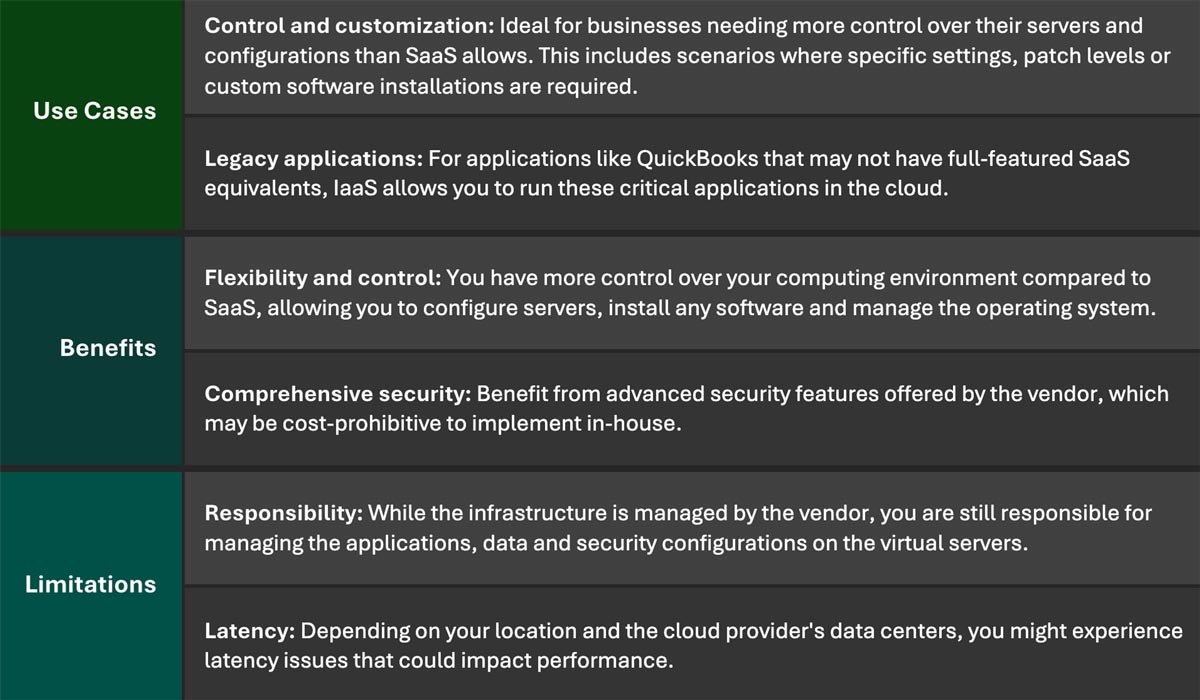
More About Software as a Service (SaaS)
You can think of SaaS applications like Uber: You don’t own or rent the car and you don’t drive the car, but you pay a fee to use the car. The use of SaaS applications is similar: You don’t own the application and have limited control over how it’s configured, but you pay a fee to use the service (usually monthly with SaaS applications).
The SaaS provider handles the maintenance and support of the applications, just like you aren’t expected to pay for the maintenance of the Uber car.
Examples include:
- Salesforce or HubSpot
- Entra ID for user and device management
- SharePoint and OneDrive for file sharing
- Line-of-business applications like QuickBooks Online
With SaaS, you can access your applications from anywhere with an internet connection without worrying about the underlying infrastructure. This model is particularly beneficial for standardized applications where customization needs are minimal.
Decision Factors for Software as a Service (SaaS)
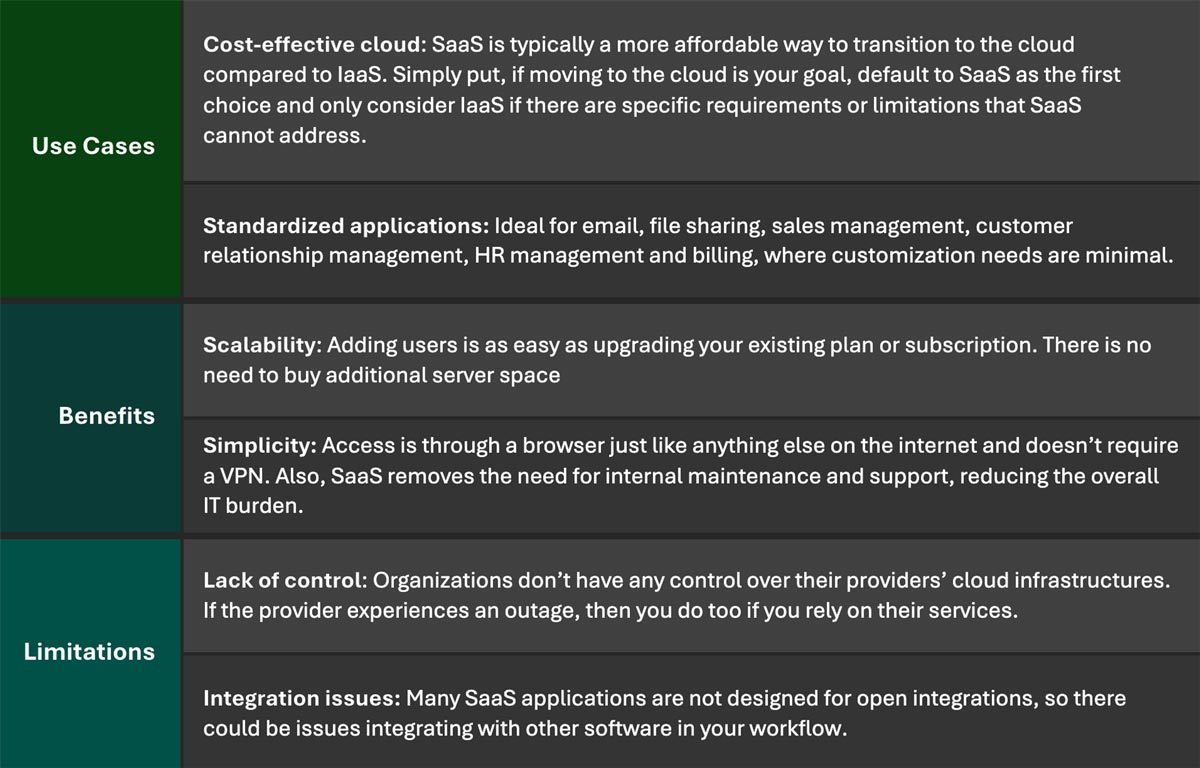
Want to Discuss Your Options?
Ultimately, IaaS offers more control, but SaaS offers easy access and less responsibility. Each also comes with limitations, so it’s important to speak with your IT team or managed service provider about the pros and cons of each solution.
Ready to move to the cloud and stop talking about server hardware? Contact Hungerford Technology here to see how they can help keep your business running smoothly while increasing productivity, security and profitability.
Contributed by:

2910 Lucerne Drive SE
Grand Rapids, MI 49546
United States
Hungerford
Email: support@hungerford.tech
Phone: (616) 949-4020
The post IaaS vs. SaaS: Your Guide to Moving to a Serverless Environment appeared first on AGN International.
]]>