The post AGN EMEA Tax Cards 2025 appeared first on AGN International.
]]>Relevant taxes include; Basis of taxation. Corporate tax. Withholding tax rate (non-treaty). Resident individual. Non-resident individual tax rates. Good and services tax. Estate duty. Stamp duty. Property tax. Income tax filing deadlines. Double tax agreements.
The post AGN EMEA Tax Cards 2025 appeared first on AGN International.
]]>The post Germany Launches Major Tax Investment Programme to Attract Business Growth appeared first on AGN International.
]]>On 11 July 2025, the Federal Council approved the law for an immediate tax investment programme to strengthen Germany as a business location.
– What do these changes mean for your clients operating in or with Germany?
– How can you help them stay compliant and seize new opportunities?
– What are the implications for internationally active businesses across EMEA?
The tax changes are intended to stimulate investment that will ensure a sustainable, growth-promoting environment and planning security for companies in Germany. The tax law changes also affect annual financial statements under commercial law and financial statements prepared in accordance with IFRS accounting standards with regard to deferred taxes.
The following measures, amongst others, were decided upon:
1. Reduction of the Corporate Tax Rate
The current tax rate of 15% will continue to apply until the end of 2027. From 2028, it will be reduced by 1% annually until it reaches 10% in 2032.
| Year | Corporate tax rate |
|---|---|
| Until 2027 | 15% |
| 2028 | 14% |
| 2029 | 13% |
| 2030 | 12% |
| 2031 | 11% |
| 2032 | 10% |
In addition to corporate tax a solidarity surcharge and a trade tax should also be paid. Trade tax is levied by the municipality in which the company has its place of business. Trade tax amounts to approximately 15%, depending on the location of the place of business. Existing deferred taxes must be revalued. Due to the gradual reduction, different tax rates must generally be applied, depending on the reversal date.
2. Reintroduction and Increase of Declining Balance Depreciation for Movable Fixed Assets – “Investment Booster”
Declining balance depreciation can be used instead of straight-line depreciation for movable fixed assets acquired or manufactured after 30 June 2025 and before 1 January 2028. The percentage to be applied may not exceed three times the percentage applicable to straight-line depreciation and may not exceed 30%.
3. Extension and Increase of the Research Allowance
The main change is the introduction of a flat-rate surcharge of 20% for the overhead and other operating costs on the assessment basis. The surcharge applies to research and development projects that start after 31 December 2025.
Furthermore, for eligible expenses incurred after 31 December 2025, the maximum assessment basis for the research allowance will increase from EUR 10 million to EUR 12 million per year. This results in a maximum research allowance of EUR 3 million per year. By raising the maximum assessment basis in conjunction with a 10% bonus, small and medium-sized enterprises will theoretically be able to apply for up to EUR 4.2 million research allowance per year in future. This applies to companies that employ fewer than 250 people and either have an annual turnover of no more than EUR 50 million or whose annual balance sheet total does not exceed EUR 43 million.
Moreover, the eligible value of hours worked for own contributions will increase from EUR 70 to EUR 100 per proven hours worked.
4. Introduction of a so called Turbo-Depreciation Allowance for Newly Purchased Electric Vehicles
The purchase of a new fully electric vehicle is to become more attractive to companies from a tax perspective. In the year of purchase, 75% of the acquisition costs can now be written off. In the following year, a further 10% can be deducted; in the second and third subsequent years 5% each, in the fourth subsequent year 3% and in the fifth subsequent year 2%. The regulation applies to the purchase of an electric vehicle in the period from July 2025 to December 2027.
Brought to you by the AGN EMEA Tax Committee
If you have any questions in relation to this article, please get in touch with Christine.

Christine Ries
Tax Consultant
Wirtschaftstreuhand Group
The post Germany Launches Major Tax Investment Programme to Attract Business Growth appeared first on AGN International.
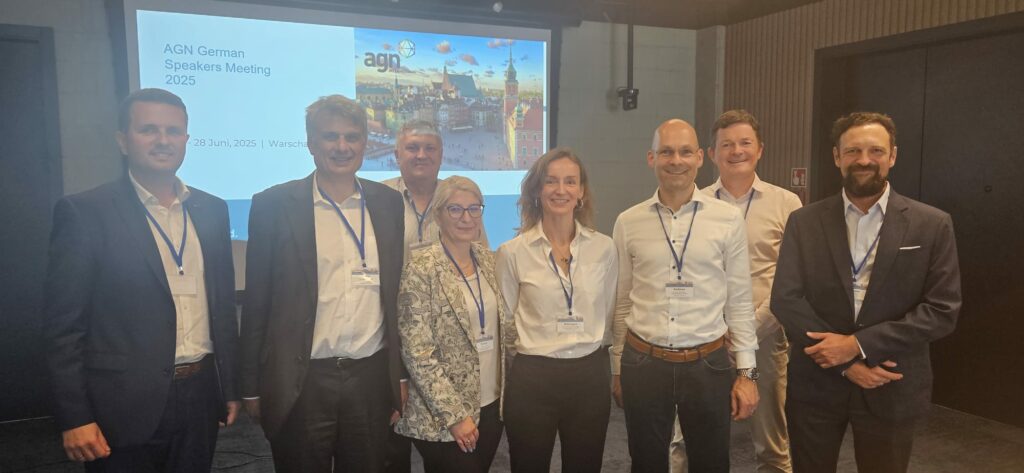
]]>The post Press Release: JRD Hosts the 2025 AGN German-Speaking Meeting in Warsaw, Poland appeared first on AGN International.
]]>A Warm Welcome to Warsaw
The meeting began on Thursday evening with a relaxed networking cruise along the Vistula River, offering attendees panoramic views of the Warsaw skyline in summer light. The friendly atmosphere was immediately evident, with many participants reconnecting after some time apart. The informal setting helped to ease into meaningful conversations and re-establish personal connections – a hallmark of AGN events.
Focused and Forward-Looking: The Technical Program
Friday featured a full day of technical sessions tailored to current challenges and opportunities in cross-border professional practice. Topics included:
- Insuring tax risk
- Exit tax regulations across EU jurisdictions
- The ESG Act: current legal status and implementation
- Setting up a subsidiary in Poland and comparative EU holding structures
- VAT treatment of e-commerce transactions and the legal framework for implementing VIDA
The day opened with a video address from AGN CEO Malcolm Ward, who provided a strategic update on the organisation’s global priorities and member initiatives.
A Cultural and Collaborative Experience
On Friday evening, attendees visited the historic Koneser Vodka Distillery, where they enjoyed a guided tour, tasting experience, and a short film produced by JRD Tax exclusively for the event. The program also included a talk on the Polish economy, a themed quiz, and a formal dinner at one of Warsaw’s top restaurants – an ideal setting for continued discussion and camaraderie.
On Saturday, those remaining took part in a guided tour of Warsaw’s Old Town, with time to explore its heritage sites and charming local streets. The cultural program added a deeper appreciation for the city and gave members more space to connect beyond the meeting room.
Shared Purpose and Lasting Value
The organisers extend their sincere thanks to all who participated, noting the high level of engagement, openness, and expertise shared across the weekend. The event reflected AGN’s ongoing commitment to building strong professional relationships, staying ahead of technical developments, and embracing the distinctiveness of its members.
Participant Reflections


“Tomasz and his team at JRD did a great job hosting the German-speaking meeting of AGN in Warsaw. Great content, excellent speakers – and best of all, you felt the heart of the great people of Poland. It felt like home to me. Looking forward to our next exchange.”
— André Marius Le Prince, Partner, WLP GmbH, Hamburg







The post Press Release: JRD Hosts the 2025 AGN German-Speaking Meeting in Warsaw, Poland appeared first on AGN International.
]]>The post AGN Taxpresso: 2025 – Issue 2 appeared first on AGN International.
]]>- Up-to-date information on tax developments in Asia Pacific countries.
- Current corporate world issues and hot topics affecting the respective countries’ economies and global development – including insight into the potential impact this could have.
- Annual budget announcements.
In this issue…
SINGAPORE
Explore how Singapore’s 2025 Budget strikes a balance between short-term economic relief and long-term growth and sustainability initiatives. Contributed by N Vimala Devi at BSL Tax Services.
PAKISTAN
Review the proposed amendments under Pakistan’s 2025 Finance Bill, highlighting key changes likely to impact businesses and investors.
The post AGN Taxpresso: 2025 – Issue 2 appeared first on AGN International.
]]>The post Central & South America Main Taxes 2025 appeared first on AGN International.
]]>Main taxes are addressed to international entities that are considering making investments in any of these countries in a way that can quickly identify business indicators that are relevant to their purposes.
This publication does not contain the extensive or detailed information required to make any decisions on investments in CSA countries. In that sense, if you are planning to do any type of action in the region, please contact professionals in the AGN firms that will provide you with legal, tax and accounting advice specific to your particular case.
The post Central & South America Main Taxes 2025 appeared first on AGN International.
]]>The post Switzerland’s Safe Harbour Interest Rates 2025: What Treasury Teams and Tax Leaders Must Know appeared first on AGN International.
]]>Introduction
Switzerland has released its Safe Harbour interest rates for 2025—benchmarks that significantly affect how multinational companies structure intra-group loans. While often overlooked due to their technical nature, these rates carry real weight for compliance, tax risk management, and treasury strategy. For finance professionals and tax advisors operating in or through Switzerland, staying informed isn’t optional—it’s essential.
What Are Switzerland’s Safe Harbour Rates—and Why Do They Matter?
Safe Harbour rates are annual reference interest rates published by the Swiss Federal Tax Administration (SFTA). These rates allow Swiss entities to comply with the arm’s length principle for intra-group loans without without complex benchmarking.
When applied correctly, Swiss tax authorities accept them as compliant—thus reducing tax audit risks.
2025 Rates: Key Updates at a Glance
| Currency | Type | 2025 |
|---|---|---|
| CHF | Minimum (equity‑financed receivables) Max operating loan (≤ CHF 1m) Max operating loan (> CHF 1m) | 1.00% 3.50% 1.75% |
| EUR | Minimum (foreign‑currency loan) | 2.50% |
| USD | Minimum (foreign‑currency loan) | 4.25% |
– Effective January 1 – December 31, 2025
– Retroactive application from January 1, 2025
Practical Considerations for Tax and Treasury Teams
- Swiss-only presumption: Foreign tax authorities may not accept these rates for cross‑border loans—transfer pricing documentation may still be needed.
- Exclusions: Short‑term funding and cash‑pooling structures do not qualify and must be benchmarked separately.
- Credit risk ignored: These rates ignore borrower creditworthiness. For loans with higher risk profiles, supporting comparable market data is essential.
- Non‑compliance risks: Applying non‑arm’s length rates without documentation can lead to hidden profit distributions and possible Swiss withholding tax of 35% (or reduced in case a Double Taxation Treaty would be applicable).
Recommended Next Steps for CFOs & Tax Leads
- Catalogue intra‑group loans: Determine eligibility for Safe Harbour treatment.
- Amend contracts to reference the 2025 Safe Harbour rates where applicable.
- Prepare transfer pricing documentation or seek tax rulings for cross‑border or high‑value loans.
- Align treasury policies to ensure consistency globally.
Conclusion: Leverage the Rules, Mitigate the Risks
The 2025 Safe Harbour rates reflect the present interest rate environment in Switzerland and serve as an effective compliance tool—when used correctly. For loans that fall outside their scope, prudent documentation or official rulings are key to avoiding tax ambiguity or material exposure.
Brought to you by the AGN EMEA Tax Committee
If you have any questions in relation to this article, please get in touch with Rocco.

Rocco Arcidiacono
Partner & Swiss certified tax expert, TEP
Fiduciaria Mega SA
The post Switzerland’s Safe Harbour Interest Rates 2025: What Treasury Teams and Tax Leaders Must Know appeared first on AGN International.
]]>The post Americas Transfer Pricing 2025 appeared first on AGN International.
]]>The post Americas Transfer Pricing 2025 appeared first on AGN International.
]]>The post Americas Tax Cards 2025 appeared first on AGN International.
]]>Use this publication to make a quick Latin American country comparison on different taxes, including Income Tax, Double Tax Treaties and more.
The post Americas Tax Cards 2025 appeared first on AGN International.
]]>The post Estonian CIT – A New Tax Incentive for Investors in Poland appeared first on AGN International.
]]>Looking to grow and reinvest profits without an immediate tax hit? Poland’s Estonian Corporate Income Tax (CIT) model offers an attractive solution.
The model was introduced based on solutions implemented in Estonia’s tax system—hence the commonly used term “Estonian CIT.” In practice, it refers to a lump-sum taxation of company income, effective only when profits are distributed to shareholders.
This taxation model is rapidly gaining popularity in Poland. More than 20,000 taxpayers are already using this system.
Under the traditional taxation system: The effective income tax rate is 34.39%, which includes CIT at the company level (19%) and personal income tax (19%) on dividend payouts.
Under the Estonian CIT model: The effective income tax rate on profit distributed to shareholders—covering both company income and dividends—generally amounts to 25%.
In practice, as long as the profit remains in the company and is reinvested, the company does not pay income tax. Upon distribution, the applicable rate is 10% (for small taxpayers) or 20% (for others), which, when combined with dividend tax, results in a total tax burden lower than that of the classical CIT model (20% and 25% respectively). Moreover, under the lump-sum model, companies are not required to pay income tax advances, and the moment of taxation is effectively postponed until the profit is paid out (as dividends). Profits for the period during which the lump-sum regime is applied are determined according to accounting regulations, simplifying and lowering bookkeeping costs.
This taxation model is applied for a consecutive period of four years and can be extended for further four-year terms.
In recent years, the 30% ruling has become increasingly popular among expats who want to come to the Netherlands and work for a Dutch employer (this could be a Dutch affiliate of the foreign employer) for a couple of years.
Who Can Use the Estonian CIT?
Businesses may opt for the Estonian CIT if they simultaneously meet the following conditions:
- Operate as: a limited liability company (sp. z o.o.), a joint-stock company (S.A.), a simple joint-stock company (P.S.A.), a limited partnership, or a limited joint-stock partnership.
- Their shareholders/partners are exclusively natural persons who do not hold property rights associated with receiving benefits as founders or beneficiaries of foundations, trusts, or similar fiduciary arrangements, excluding founders and beneficiaries of family foundations.
- The company does not hold shares (equity) in other companies, participations in investment funds or collective investment institutions, or rights and obligations in partnerships that are not legal persons.
- Passive income in the preceding tax year does not exceed 50% of total revenue—this includes revenue from receivables, copyrights, industrial rights, interest, or income from various loans, which must not dominate over operational activity.
- Employ at least 3 employees (excluding shareholders or partners), calculated in full-time equivalents, for at least 300 days in the tax year or incur expenses on civil law contracts that amount to at least three times the average monthly wage in the enterprise sector.
- Maintain accounting records in compliance with the National Accounting Standards at the time of entering the Estonian CIT regime.
Some of the above conditions are relaxed for newly established businesses and small taxpayers during their first year under the Estonian CIT model.
To apply for Estonian CIT, a business must notify the appropriate head of the tax office by the end of the first month of the first tax year in which the new rules are to apply. The decision to change the tax settlement method can also be made during the tax year—in such cases, accounting books must be closed and financial statements prepared on the last day of the month preceding the switch.
Who Cannot Use the Estonian CIT?
Entities excluded from the lump-sum taxation model include, among others, financial institutions (including domestic banks), lending institutions, companies in bankruptcy or liquidation, and—temporarily—companies formed through mergers or splits. This regime is also unavailable to holding companies, subsidiaries with legal entity shareholders, investment funds, and venture capital vehicles.
Reinvestment Instead of Tax – Potential Benefits for Companies
The Estonian CIT model can deliver real benefits to businesses—particularly through tax deferral, simplified tax settlements, and improved liquidity thanks to the ability to reinvest all profits. The model rewards companies that actively invest and expand their operations. This form of taxation is available to companies with simple ownership structures—those whose shareholders are exclusively natural persons. These may be both Polish and foreign tax residents.
However, companies must carefully analyse their financial situation and operational structure before opting for the Estonian CIT—considering both tax advantages and potential risks related to failure to meet statutory conditions or reporting errors. Under this regime, not only the actual profit is taxed, but also so-called “hidden profits.” These are benefits received by shareholders of a company under Estonian CIT that are treated as equivalent to dividends by law (e.g., when a legal transaction leads to the same economic result as a dividend payout, such as interest payments on loans, renting property, or providing company cars to shareholders). It is therefore essential to analyze all benefits exchanged between the company and its shareholders in terms of their potential classification as hidden profits. If such transactions occur, it is crucial to ensure that they are carried out on market terms.
Brought to you by the AGN EMEA Tax Committee
If you have any questions in relation to this article, please get in touch with Tomasz.

Tomasz Paszkowski.
Tax Advisor, JRD
Web: https://jrd.pl
Email: tomasz.paszkowski@jrd.pl
Phone: +48 22 654 02 14
Connect on LinkedIn
The post Estonian CIT – A New Tax Incentive for Investors in Poland appeared first on AGN International.
]]>The post AGN Taxpresso: 2025 – Issue 1 appeared first on AGN International.
]]>- Up-to-date information on tax developments in Asia Pacific countries.
- Current corporate world issues and hot topics affecting the respective countries’ economies and global development – including insight into the potential impact this could have.
- Annual budget announcements.
In this issue…
Message from the Chairman:
Richard Ashby notes rising tax authority pressure and aggressive enforcement, highlights continued committee engagement across Asia Pacific, and invites member feedback and participation in future AGN Taxpresso editions.
China: Export Tax Rebates
China ended or reduced export tax rebates on key commodities, aiming to prioritise domestic needs, triggering global market volatility, trade tension concerns, and potential supply chain disruptions. Contributed by Mandy Liu, Acclime.
New Zealand: Exposure to GST
Non-resident businesses may need to register for New Zealand GST (Goods and Services Tax) if they exceed NZD 60,000 in supplies, with specific rules for goods, remote services, low-value imports, and refund eligibility. Contributed by Richard Ashby, Gilligan Sheppard.
The post AGN Taxpresso: 2025 – Issue 1 appeared first on AGN International.
]]>