The post AGN EMEA Tax Cards 2025 appeared first on AGN International.
]]>Relevant taxes include; Basis of taxation. Corporate tax. Withholding tax rate (non-treaty). Resident individual. Non-resident individual tax rates. Good and services tax. Estate duty. Stamp duty. Property tax. Income tax filing deadlines. Double tax agreements.
The post AGN EMEA Tax Cards 2025 appeared first on AGN International.
]]>The post Germany Launches Major Tax Investment Programme to Attract Business Growth appeared first on AGN International.
]]>On 11 July 2025, the Federal Council approved the law for an immediate tax investment programme to strengthen Germany as a business location.
– What do these changes mean for your clients operating in or with Germany?
– How can you help them stay compliant and seize new opportunities?
– What are the implications for internationally active businesses across EMEA?
The tax changes are intended to stimulate investment that will ensure a sustainable, growth-promoting environment and planning security for companies in Germany. The tax law changes also affect annual financial statements under commercial law and financial statements prepared in accordance with IFRS accounting standards with regard to deferred taxes.
The following measures, amongst others, were decided upon:
1. Reduction of the Corporate Tax Rate
The current tax rate of 15% will continue to apply until the end of 2027. From 2028, it will be reduced by 1% annually until it reaches 10% in 2032.
| Year | Corporate tax rate |
|---|---|
| Until 2027 | 15% |
| 2028 | 14% |
| 2029 | 13% |
| 2030 | 12% |
| 2031 | 11% |
| 2032 | 10% |
In addition to corporate tax a solidarity surcharge and a trade tax should also be paid. Trade tax is levied by the municipality in which the company has its place of business. Trade tax amounts to approximately 15%, depending on the location of the place of business. Existing deferred taxes must be revalued. Due to the gradual reduction, different tax rates must generally be applied, depending on the reversal date.
2. Reintroduction and Increase of Declining Balance Depreciation for Movable Fixed Assets – “Investment Booster”
Declining balance depreciation can be used instead of straight-line depreciation for movable fixed assets acquired or manufactured after 30 June 2025 and before 1 January 2028. The percentage to be applied may not exceed three times the percentage applicable to straight-line depreciation and may not exceed 30%.
3. Extension and Increase of the Research Allowance
The main change is the introduction of a flat-rate surcharge of 20% for the overhead and other operating costs on the assessment basis. The surcharge applies to research and development projects that start after 31 December 2025.
Furthermore, for eligible expenses incurred after 31 December 2025, the maximum assessment basis for the research allowance will increase from EUR 10 million to EUR 12 million per year. This results in a maximum research allowance of EUR 3 million per year. By raising the maximum assessment basis in conjunction with a 10% bonus, small and medium-sized enterprises will theoretically be able to apply for up to EUR 4.2 million research allowance per year in future. This applies to companies that employ fewer than 250 people and either have an annual turnover of no more than EUR 50 million or whose annual balance sheet total does not exceed EUR 43 million.
Moreover, the eligible value of hours worked for own contributions will increase from EUR 70 to EUR 100 per proven hours worked.
4. Introduction of a so called Turbo-Depreciation Allowance for Newly Purchased Electric Vehicles
The purchase of a new fully electric vehicle is to become more attractive to companies from a tax perspective. In the year of purchase, 75% of the acquisition costs can now be written off. In the following year, a further 10% can be deducted; in the second and third subsequent years 5% each, in the fourth subsequent year 3% and in the fifth subsequent year 2%. The regulation applies to the purchase of an electric vehicle in the period from July 2025 to December 2027.
Brought to you by the AGN EMEA Tax Committee
If you have any questions in relation to this article, please get in touch with Christine.

Christine Ries
Tax Consultant
Wirtschaftstreuhand Group
The post Germany Launches Major Tax Investment Programme to Attract Business Growth appeared first on AGN International.
]]>The post Press Release: The AGN 2025 Asia Pacific Regional Meeting Drives Collaboration Through Change appeared first on AGN International.
]]>The two events brought together over 120 participants from both AGN and Nexia, offering a valuable opportunity to connect, exchange ideas, and further strengthen the collaborative relationship between the two associations in the region.
The meeting kicked off on the evening of 9 July with a traditional Thai welcome dinner, offering a relaxed atmosphere for attendees to get to know one another while experiencing the city’s culture.
Learning and Growing Together
Thursday’s programme began with an AGN-only session, featuring a thought-provoking panel discussion on sustainability management, moderated by Kevin Bae and Tim Suryanata of Calibre Business Advisory (Australia and Singapore). Panellists from China, India, Indonesia, and New Zealand shared insights on in-demand services and key aspects of capability management across various jurisdictions.
Andrew White from Ashfords, Australia, shared inspiring insights from the AGN Talent Secondment Programme, highlighting the benefits of cross-border collaboration through staff exchanges with Ballards LLP in the UK.
Malcolm Ward, AGN Global CEO, and Mireia Rovira, AGN Director of Brand and Member Value, then led an engaging session on “Calibrating Your International Business Strategy.” They introduced key concepts to build international business strategy, highlighting some of the tools and resources available to members. This was followed by a workshop to discuss practical strategies and challenges in smaller groups.
Later in the day, delegates experienced some of Bangkok’s iconic culture, visiting Wat Arun (Temple of Dawn) and Wat Pho (Temple of the Reclining Buddha), followed by a memorable dinner aboard the Horizon Cruise on the Chao Phraya River—enjoying five-star cuisine with stunning views of the city at night.
Sharing Experiences and Building Value
Friday morning began with a breakfast discussion for women from AGN Asia Pacific firms, creating a supportive space to exchange stories, challenges, and successes. The session also aimed to guide firm leaders on how to attract, retain, and promote talent by understanding and embracing the unique challenges women face in the profession.
The half-day conference began with opening remarks delivered by Nexia’s APAC Chair, Krupal Kanakia, and AGN’s APAC Chair, Greg Cusack, then continued with updates on our collaborative alliance presented by Nexia’s CEO Matthew Howell, and AGN’s Global CEO Malcolm Ward. Delegates then dived into two key sessions: Nexia presented about Talent Management, focusing on career development frameworks, and AGN team focused on Building Value to Firms, showcasing the approach on member value with focus on the Technology space, in context with the transformation of the competitive space. A quick assessment showed how firms rated priorities on this area.
After lunch, some AGN delegates joined an optional tour to explore Ayutthaya—Thailand’s former capital and UNESCO World Heritage Site. The tour included a visit to the Elephant Palace & Royal Kraal to learn about the cultural importance of elephants, a guided walk, through Ayutthaya Historical Park, and concluded with a scenic dinner at Grand Chaopraya Riverside Dining.

“I’ve been a member of AGN for almost ten years. One of the key takeaways from this year’s conference was the importance of focusing more on international business — something that really stood out to me during Malcolm and Mireia’s session. This is also my second conference attended alongside Nexia members. It was great to reconnect with some I met last year and meet new ones. I really enjoyed connecting with them.”
Manoj Chawla – KNM, India

“It’s been a great experience to be part of the 2025 Asia Pacific Regional Meeting in Bangkok. I really enjoyed the sustainability management panel discussion on Thursday morning. I learned a lot, especially about regional collaborations and the challenges in the region. I’m going home with great memories.”
Yun Shan (Sandy) Lin, CPA at EnWise CPAs & Co, Taiwan
A Meaningful Gathering for the Region
The AGN Asia Pacific Regional Meeting 2025 blended insightful professional discussions with rich cultural experiences, helping members strengthen their connections and discover new ideas to support growth and collaboration across borders.





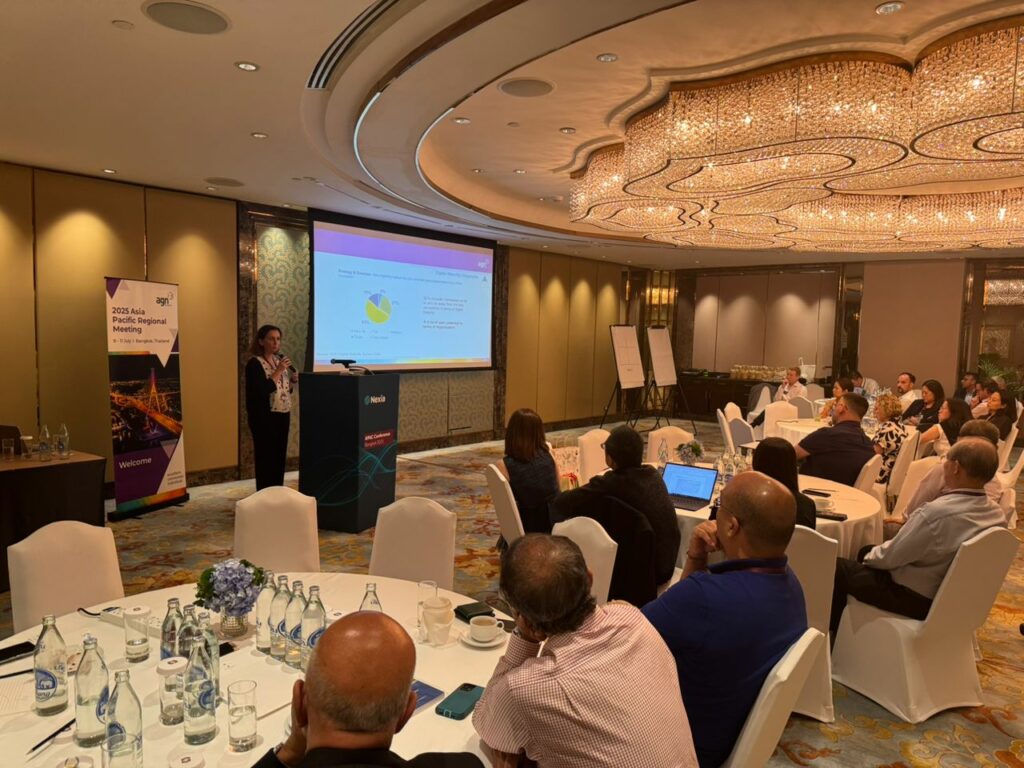


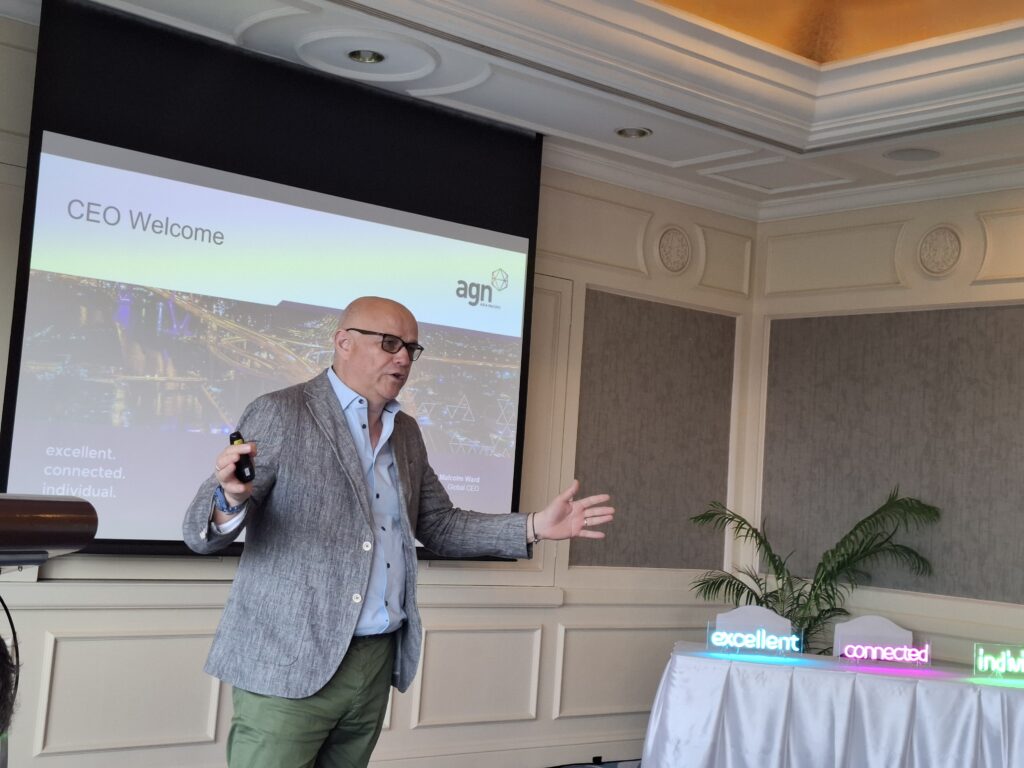

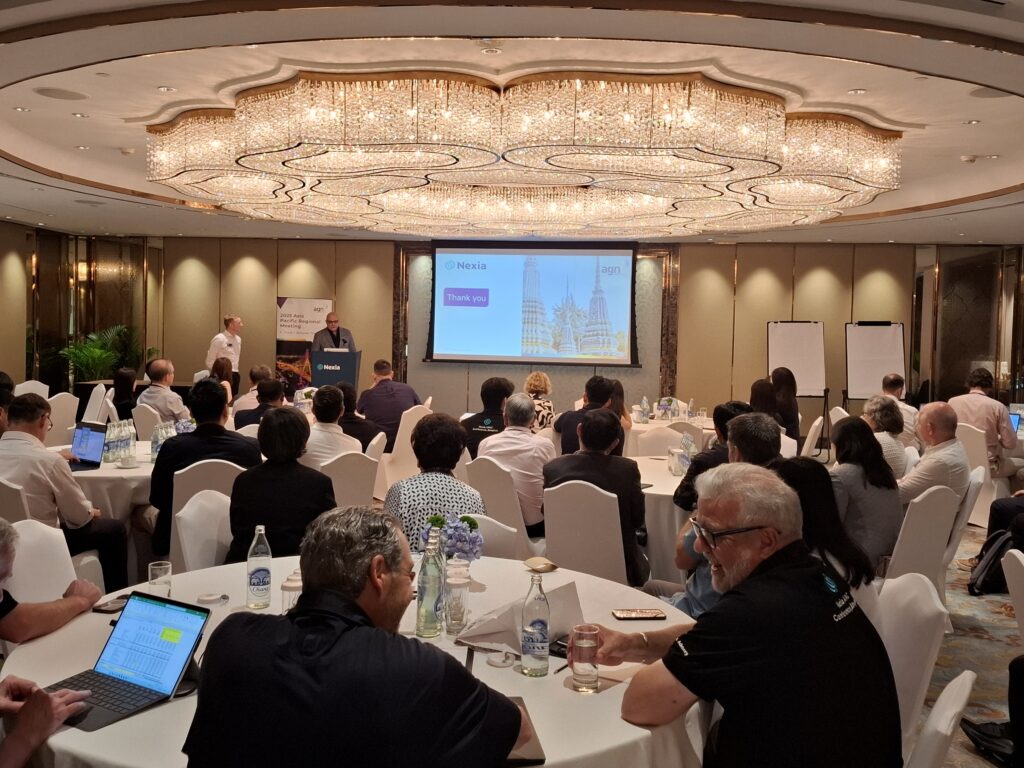


The post Press Release: The AGN 2025 Asia Pacific Regional Meeting Drives Collaboration Through Change appeared first on AGN International.
]]>The post A Guide to Funding Future Investment – Raise new capital funds or is it time to sell up? appeared first on AGN International.
]]>Audio bite.
Funding Future Investment – Raise new capital funds or is it time to sell up?
Investing in new technologies and funding new skills and fresh talent, all while maintaining independence and your firms unique culture, is no doubt a tall order. The pressure to embrace and resolve these matters is relentless. Competitive pressure, productivity and workload pressure or the pressure of modernizing and transforming your business in the face of near constant developments in technology – all bring the need for capital funds into focus. Some firms rely on a strong balance sheet with reinvested profits. Others draw on modest capital injections from retained earnings, bank lending, or new equity partners, or external backing.
This AGN Global Business Voice publication synthesizes seven strategic capital-raising routes available to AGN member firms. Each has unique advantages, trade-offs. Their strategic fits depending on the firm’s objectives, risk appetite, and ownership philosophy.
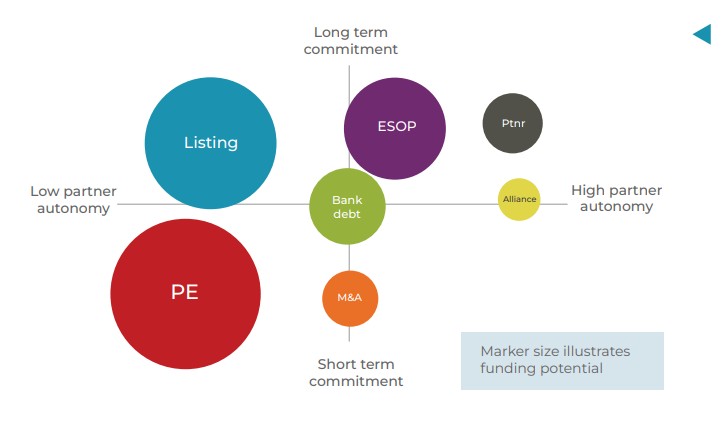
Strategic Financing Options Mapped by partner autonomy,
timescale commitment &
funding potential
Left, is an illustrative schematic comparing relative partner autonomy, timescale commitment and funding
potential between options. Individual circumstances and deal structures vary widely, impacting this assessment, and
below we explore the potential pros and cons of all these approaches.

On the move?
Tune into our mini podcast on Spotify at the end of this article for a quick summary of the key insights.
Below is AGNs checklist of matters you should consider at the start of your journey to raise capital resources for your firm: The checklist would make useful section headings for an internal project report.
| AGN Capital Raising Checklist… At a very high level there are a series of practical steps that members should consider at the beginning of a journey to raising required capital funding: |
|---|
| 1. Conduct a strategic capital needs assessment |
| 2. Evaluate your current financial and ownership position |
| 3. Map all viable funding options |
| 4. Engage and align key stakeholders |
| 5. Develop a capital raising plan |
| 6. Strengthen your attractiveness to investors or lenders |
| 7. Seek specialist advice early |
| 8. Use AGN tools & networks |
| 9. Balance growth with culture |
| 10. Plan for integration, repayment, or exit |
Funding Future Investment 1: Strategic Alliances and Partnerships
Perhaps not the most obvious starting point, but perhaps it’s possible to avoid the need for raising capital altogether? Strategic alliances involve partnering with another organization to drive mutual growth—without full mergers. Accounting firms may align with other firms, consulting or tech businesses, or join investor-backed networks. These arrangements aim to leverage strengths such as client bases, expertise, or technology access. While alliances typically don’t bring a large one-time capital injection, they often reduce capital needs and generate new revenue.
| Benefits | Challenges |
|---|---|
| 1. Access to Resources and Technology Alliances help firms access tech or skills they lack in-house. A mid-sized firm could benefit from a partner’s AI auditing tools, cybersecurity capabilities, or back-office systems—improving digital maturity without full cost burden. | 1. Limited Capital Injection Unless the alliance includes investment, there’s no direct cash inflow. While some models (e.g., VC-backed alliances) do invest in member firm tech, most deliver value indirectly via referrals or shared tools. |
| 2. Expanded Services and Market Reach By teaming up, firms can offer broader solutions—e.g., combining tax services with IT consulting. Alliances open new markets and client opportunities that would otherwise be inaccessible alone. | 2. Coordination Complexity Alliances require effort to align on fees, roles, and quality. Joint projects need clear structures. Mismanagement can confuse clients or delay outcomes. |
| 3. Shared Costs and Risk Collaborative initiatives split costs. Firms might jointly develop a platform or co-market services, lowering financial exposure for each. | 3. Potential for Conflict or Dependency Disagreements can arise if goals diverge. Over-reliance on a partner for key resources creates risk if the relationship ends or underperforms. |
| 4. Independence Retained Alliances preserve local identity and control. Firms keep their branding and decision-making while benefiting from scale advantages like training and infrastructure. | 4. Brand Dilution If not carefully positioned, a firm’s individual identity may be overshadowed. Success may be attributed to the alliance instead of the firm, affecting perception and control over marketing. |
| 5. Talent and Client Appeal Affiliation with broader networks or firms enhances credibility. It reassures clients and appeals to recruits who want big-firm resources with small-firm culture. | 5. No Guaranteed Results Alliances require active participation. Without follow-through, benefits may not materialize. Unlike mergers, alliances can fade if neglected. |
Suitability for Medium-Sized Firms
Alliances are ideal for firms seeking capability growth over sheer size. For example, a 15-partner firm strong in compliance might partner with a consulting boutique to add advisory depth. Joining an international network allows service expansion across borders, and tech alliances can support transformation goals at lower costs.
Ownership Impact
Most strategic alliances do not involve equity transfer. Firms remain independently owned. For instance, if a tax firm allies with a tech consultancy, ownership doesn’t change—just a contractual collaboration forms.
Some newer alliance models include small equity stakes—usually in non-attest services—funded by investors. Even then, these are minority holdings and preserve autonomy. Any equity dilution is typically minimal and structured to
retain partner control.
Application Across Timeframes
Short-Term
Quick wins may include shared client opportunities or access to new tools. For example, a firm could immediately pitch for a larger client using its partner’s capabilities.
Medium-Term (1–3 yrs)
With active collaboration, referrals
grow, services integrate, and costs reduce. For example after two years, a firm might see 10–15% of new business linked to
the alliance.
Long-Term (3–5+ yrs)
Strong alliances can deepen, evolve into mergers, or become
a firm’s key strategic pillar. International affiliations, for example, support consistent
innovation and client expansion over time.
Suitability for Medium-Sized Firms
Alliances are ideal for firms seeking capability growth over sheer size. For example, a 15-partner firm strong in compliance might partner with a consulting boutique to add advisory depth. Joining an international network allows service expansion across borders, and tech alliances can support transformation goals at lower costs.
Conclusion
Strategic alliances offer a balanced path to growth. While not suited for firms needing fast capital, they enable mid-sized practices to stay competitive, broaden their offer, and access tech—all without giving up control. For firms that want to remain themselves but do more, alliances are a powerful tool. They amplify capabilities, reduce cost burdens, and allow firms to punch above their weight—especially when well-managed and mutually beneficial.
Funding Future Investment 2: Private Equity Investment
PE firms see medium-sized accountancy practices as attractive due to recurring revenues, strong client relationships, and potential for digital and service transformation. These firms provide a foundation for platform-building, where PE can drive rapid growth through add-on acquisitions and operational efficiency.
Why Private Equity Is Interested in Accounting Firms:
PE firms look for:
- Strong EBITDA performance
- Growth potential
- Recurring revenue
- Niche expertise
- Leadership & succession
- Digital readiness
- Cultural fit
Firms demonstrating digital maturity, operational efficiency, and strategic clarity are especially appealing Introduction. Firms with specialist services (e.g., tax, corporate finance, ESG, or tech consulting) often command higher valuations, especially when they’ve embraced digital tools and can scale.
| Benefits | Challenges |
|---|---|
| 1. Significant Capital Injection PE provides large amounts of capital to fund expansion, technology upgrades, M&A, and new service lines—enabling faster transformation than organic growth alone. | 1. Loss of Independence PE investors typically require control or strong influence—meaning partners may lose autonomy over key decisions and the firm’s strategic direction. |
| 2. Liquidity for Partners Partners can cash out part or all of their equity, offering an exit path or personal wealth diversification—particularly useful for retiring founders. | 2. Cultural Clash Risk The commercially-driven approach of PE can conflict with traditional partner culture— especially if decisions become overly profit-driven. |
| 3. Access to Strategic Expertise CPE firms bring experience in scaling businesses, improving operational efficiency, and driving profitability—often through professionalised governance and systems. | 3. Pressure for High ROI and Exit PE has a defined time horizon (typically 3–7 years) and will push for aggressive growth and an eventual exit—often a sale or IPO. (Known as a ‘flip). |
| 4. Accelerated Growth With financial backing, firms can move quickly into new geographies or markets, acquire competitors, and scale niche services. | 4. Dilution of Ownership Existing partners must give up equity in exchange for capital. From the get go founders may hold only a minority stake. (Although there are examples of PE taking a minority stake). |
| 5. Talent Attraction and Retention Equity-linked incentives (e.g. options or profit-sharing schemes) can attract high-performing professionals who want ownership or upside in growth. | 5. Staff Disruption Uncertainty about changes in leadership, roles, or firm direction can unsettle staff. If not managed well, it can lead to attrition. |
| 6. Enhanced Valuation Through Transformation Digitalisation, specialisation, and consolidation driven by PE can increase the overall value of the firm beyond what could be achieved solo. | 6. Complexity and Legal Restructuring A PE deal often requires reorganisation of the firm structure (e.g., incorporation), changes to ownership rules, and significant legal and advisory costs. |
| 7. Debt Treatment Firms should be cautious around how the investment debt is treated. If it’s added to the firms own P&L then this creates greater risk and a significant repayment burden. |
Potential Challenges & Trade-offs
Engaging with PE isn’t without risk. Key challenges include:
- Cultural change
- Potential loss of autonomy
- Staff engagement
- Exit strategies
AGN members should assess whether they’re ready for the demands and shifts that come with PE capital.
What’s the Opportunity for AGN Members?
Valuations are typically based on a multiple of EBITDA, adjusted for growth potential, risk profile, and strategic assets. Factors increasing valuation include:
- Demonstrably strong client retention
- Revenue from advisory and niche services
- Scalable operating models
- Use of AI or cloud systems
- Leadership continuity
Multiple uplift can range from 5x EBITDA for traditional firms to 10–12x for digitally mature firms.
What members can do next?
AGN firms can:
- Learn from peers – AGN members include a raft of firms that have taken PE investment.
- Use diagnostics to assess readiness – The AGN Advisory Migration Diagnostic, the AGN Digital Maturity Diagnostic and the AGN Practice Performance Diagnostic.
- Explore advisory migration through discussions with AGN member firms that are advanced in their journey.
- Build regional platforms with scale – AGN includes members that have catapulted their growth and scale country based acquisitions.
Funding Future Investment 3: Bank & Debt Financing
Banks, credit organisations and other financial institutions allow firms to raise capital via debt—commonly through term loans, lines of credit, or specialized instruments. Accounting firms with stable revenue streams can often secure sizable loans, though usually with personal guarantees equity or seconded on Trading history or forecast future performance. While debt doesn’t dilute ownership, it does require repayment with interest.
| Benefits | Challenges |
|---|---|
| 1. Retain Full Ownership Firms maintain complete control. Unlike equity, bank loans don’t involve giving up any stake or inviting external influence on decisions. | 1. Repayment Risk Loan repayments are mandatory regardless of business performance. Revenue dips can strain finances, leading to potential default. |
| 2. Flexible Use of Funds Loan proceeds can typically be used for a broad range of business needs—from IT upgrades to marketing, hiring, or office renovations. This flexibility supports growth strategies like digital transformation. | 2. Interest and Fees Loans incur interest and potentially other costs (e.g., origination fees). With rising interest rates, the cost of new debt has grown. |
| 3. Tailored Terms Different loan types suit different horizons: Short-term: working capital or seasonal needs. Medium-term: growth projects. Long-term: durable assets like office buildings or major IT systems. | 3. Collateral and Guarantees Banks typically require collateral or partner guarantees, sometimes, not always, placing personal assets at risk. |
| 4. Lower Cost of Capital Interest payments (often tax-deductible) may be cheaper in the long run than giving away a share of profits to equity investors. | 4. Loan Covenants Loan agreements often contain restrictions. Breaching these may lead to penalties or loan recall. |
| 5. Familiar, Streamlined Process Banks have established lending procedures and often understand professional service firms. Predictable revenues and strong client retention help firms qualify. | 5. Limited Capital Availability Loan amounts are constrained by cash flow and collateral and business performance. Medium-sized firms might secure less than equity could provide. |
| 6. No Strategic Input Banks offer no strategic advice or mentorship— just capital. |
When It’s a Good Fit
Bank financing suits firms with reliable income, financial discipline, and clear ROI plans. Examples include investing in new software or expansion that can be repaid from increased future revenue.
Preserving Independence
Debt financing doesn’t alter ownership. Profits stay internal after interest. While lenders may require transparency, they don’t interfere with governance.
Application by Time Horizon
Short-Term
Revolving lines of credit are ideal for temporary cash flow gaps or seasonal needs.
Medium-Term (1–3 yrs)
3–7 year loans suit projects like digital upgrades or launching new services.
Long-Term (3–5+ yrs)
Real estate or highly durable needs can justify 10+ year loans,
though they’re uncommon for
intangible investments.
Conclusion
Bank financing is a practical, non-dilutive funding route for medium-sized firms. It supports independence and growth if firms are financially disciplined and confident in their repayment capacity.
Funding Future Investment 4: Employee Stock Ownership Plans (ESOPs)
An Employee Stock Ownership Plan (ESOP) allows a firm to transfer ownership to employees through a trust, often using a loan (leveraged ESOP) to buy partner shares. Over time, profits repay the loan and shares are allocated to employees— usually based on salary or tenure. It’s a form of internal succession and financing, with the added benefit of boosting engagement and retention. Though rare in accounting, ESOPs are gaining traction after BDO USA’s notable adoption in 2023.
| Benefits | Challenges |
|---|---|
| 1. Strong Talent Retention and Attraction ESOPs give employees a stake in the firm’s success, often boosting loyalty and engagement. As a no-cost retirement benefit, it helps firms stand out in recruitment and signals a people-first culture. | 1. Complex and Costly Setup Creating an ESOP requires restructuring as a corporation, hiring specialists, annual valuations, and ongoing regulatory compliance. These administrative costs can be burdensome for smaller or less profitable firms. |
| 2. Internal Ownership Transition ESOPs preserve independence—ownership transfers to employees, not outsiders. Leadership remains intact, and governance can be structured to retain partner control, making it a strategic way to raise capital while staying private. | 2. Financial Risk via Debt Many ESOPs require loans, creating substantial debt that the firm repays over time. If cash flow falters, the burden can strain finances—especially in firms without strong recurring revenue. |
| 3. Succession and Liquidity for Partners Selling to an ESOP allows retiring partners to exit gradually or all at once. The firm buys equity at fair market value via ESOP loans or contributions—often offering better terms than internal sales while preserving the firm’s legacy | 3. Ownership Dilution Partners’ equity shrinks as shares transfer to employees. Though philosophically easier to accept than outside investors, it still changes firm dynamics and requires partners to embrace a broader ownership model. |
| 4. Tax Benefits In some countries contributions to the ESOP are tax-deductible, and in S-corps, profits attributable to ESOP ownership can be tax-free and/or sellers may defer capital gains tax. The tax advantage vary. | 4. Future Repurchase Obligation In some ESOP arrangements, employees retire or leave, the firm must buy back their ESOP shares. This liability can grow over time and must be planned for to avoid cash flow constraints later. |
| 5. Performance Gains Firms with ESOPs often outperform peers in productivity and profitability due to greater employee motivation. A culture of ownership can lead to better service, innovation, and retention—supporting long-term growth. | 5. Licensing and Regulatory Challenges Some jurisdictions limit non-CPA ownership. ESOPs must be carefully structured to avoid breaching regulations, particularly in audit-focused practices, potentially limiting the firm’s ability to go fully ESOP-owned. |
Suitability for Medium-Sized Firms
ESOPs work well for firms with steady profits, low debt, and a deep team—especially those facing leadership succession. If a firm has retiring partners and engaged staff, an ESOP can align interests, provide exit capital, and retain independence.
Applicability Over Time
Short-Term (Year 1)
Setting up takes 6–12 months. Immediate benefits include liquidity for selling partners and a morale
boost from employee ownership. Operationally, the firm sees little change—no immediate growth or
client influx.
Medium-Term (1–5 yrs)
The firm begins servicing the ESOP loan, adjusting cash
flow. Employees start seeing themselves as owners, which can improve engagement
and retention. The firm might start attracting talent with its employee-owned status and market itself differently.
Long-Term (5–10+ yrs)
RWith the loan repaid, the firm’s financial position strengthens.
Employees accumulate
meaningful retirement value. The firm may complete its succession plan via additional
ESOP transactions and sustain a strong, independent model.
Ownership Impact
A typical ESOP transaction sees the trust owning 20–40% of the firm. Employees benefit economically, but governance often remains with partners or a designated trustee. Over time, some scenarios mean that firms can transition to 100% employee ownership—though many remain partially ESOP-owned to balance control and shared benefits.
Conclusion
An ESOP is a strategic, long-term ownership and capital solution—not a quick fix. It supports gradual succession, can build a performance culture, and is likely to help firms preserve independence while rewarding staff. For medium-sized firms with a long view and strong fundamentals, ESOPs can support cultural and financial continuity.
Funding Future Investment 5: Internal Partner Funding
Internal funding involves using the firm’s own partners—current or incoming—to raise capital. This can be through capital contributions, retained earnings, or new partner buy-ins. It’s a traditional method that keeps ownership within the firm, often facilitating generational succession.
| Benefits | Challenges |
|---|---|
| 1. Preserved Control and Culture Ownership stays within the practitioner group, maintaining the firm’s culture, autonomy, and long-term service values. No external influence alters strategic decisions. | 1. Limited Capital Funds are constrained by partners’ personal means or firm profits. Buy-ins, while valuable, are often modest compared to what external investors could offer. |
| 2. Trusted and Familiar Processs Internal funding involves people who know the firm, making transitions smoother. Retiring partners can often choose successors, and trust simplifies negotiations. | 2. Personal Financial Burden New and existing partners may need personal loans or dip into savings or access to a firms banking equity loan. This can deter prospective partners, affecting retention and succession. |
| 3. Flexible Terms Buyouts and capital injections can be structured to suit cash flow—payouts spread over years, staged buy-ins, or firm-arranged loans—all negotiable internally. | 3. Slower Growth form Investment Strategy Growth maybe more gradual, limited by internal resources. Larger investments may be postponed or broken into phases, risking competitive disadvantage. |
| 4. Talent Development Incentive Creating ownership opportunities motivates high performers. Offering equity stakes fosters loyalty and strengthens the leadership pipeline. | 4. Strain from Retirement Payouts Deferred payments to retiring partners can drain profits—especially with multiple retirements— reducing funds available for growth. |
| 5. Simplified Regulatory Compliance No need for outside approvals or restructuring. As new owners are typically licensed professionals, ownership remains in compliance with regulatory standards. | 5. Risk of Inequity or Tension Differences in buy-in amounts or timing may lead to perceived unfairness. Ownership could skew toward those with deeper pockets, rather than merit. |
Suitability for Medium-Sized Firms
Internal funding is ideal for stable, independently minded firms with upcoming leaders. It suits planned, moderate capital needs—like phased tech upgrades or service expansion—and firms aiming for long-term sustainability.
For instance, a 15-partner firm with retiring seniors and rising managers might use this model to transfer ownership and raise funds simultaneously. It works well when firms reinvest profits year over year, supporting continuous but controlled evolution.
Use Across Timeframes
Short-Term
Firms can defer distributions or call
for small capital injections from partners to manage short-term needs. These measures help bridge cash flow gaps or seed smaller projects.
Medium-Term
A plan to admit new partners and retain earnings over 1–5 years can fund initiatives like office expansions or IT upgrades. Discipline and forecasting are key.
Long-Term
A steady intake of new partners and ongoing reinvestment builds capital slowly but
securely. Firms might allocate a percentage of revenue annually
into a development or tech fund—aligning capital formation
with strategy.
Ownership Impact
Internal funding maintains full control within the partner group. While equity percentages shift as partners enter or retire, there’s no external ownership dilution. New partner contributions strengthen the firm’s balance sheet and
support future investments.
In some firms, senior staff may hold small stakes, but ownership still remains internal. This approach reinforces legacy and succession, creating continuity from one generation of partners to the next.
Limitations and Considerations
Internal funding can struggle to meet urgent or large-scale investment needs. For example, a sudden need to adopt an expensive new audit platform might exceed the firm’s internal capacity. If no one is willing or able to buy in, internal succession plans can falter, making external
funding necessary.
For these reasons, many firms use internal funding as a foundation but remain open to supplementing it with loans or outside capital for larger or time-sensitive projects.
Conclusion
Internal partner funding is the most traditional financing method for professional service firms. It supports control, stability, and long-term continuity, but comes with limits on capital availability and speed.
It’s most effective when aligned with a forward-looking succession plan and used for investments that can be planned and phased over time. For medium-sized accounting firms prioritizing independence, internal funding provides a reliable, sustainable approach—especially when supplemented with other capital sources as needed.
Funding Future Investment 6: Mergers or Acquisitions (Strategic M&A)
Merging with or being acquired by another firm can inject capital, solve succession issues, and provide scale. It trades independence for resources and often forms part of consolidation strategies in the accounting sector.
| Benefits | Challenges |
|---|---|
| 1. Immediate Scale & Resources Gains access to tech, clients, and infrastructure of a larger firm. | 1. Loss of Identity Merging typically ends a firm’s independent branding and culture. |
| 2. Partner Liquidity Partners can cash out or take shares, reducing risk. | 2. Client/Staff Disruption Risks include client attrition, redundancies, and morale issues. |
| 3. Staff Opportunities Offers broader career paths and may improve retention. | 3. Strategic Shift Risk Larger firm may phase out services or clients the smaller firm values. |
| 4. Succession Planning Solves retirement transitions without needing internal successors. | 4. Earn-outs & Status Loss Deals may include performance targets, and former partners might lose authority. |
| 5. Potential Equity Upside Partners may benefit from larger firm’s future growth if shares are received. | 5. Regulatory Changes New compliance obligations (e.g., independence rules) may apply. |
Suitability
Ideal for firms lacking internal succession or facing tech/cost pressures. A one-time, long-term strategic shift offering short-term liquidity and stability under a larger platform.
Ownership Impact
Original ownership dissolves. Partners either cash out or join a larger ownership pool. This is full dilution in exchange for future security and support.
Funding Future Investment 7: Public Listing or IPO (Initial Public Offering)
An Initial Public Offering (IPO) represents a bold capital-raising move—opening a professional services firm to public investment by listing on a stock exchange. Although rare in the accountancy world, a handful of firms, particularly in legal and advisory services, have paved the way. Going public can unlock substantial capital, raise brand visibility, and enable rapid expansion—but not without significant governance and regulatory burdens.
| Benefits | Challenges |
|---|---|
| 1. Access to Large-Scale Capital IPOs can raise significant funds for expansion, acquisitions, or technological upgrades. Large institutional investors often provide long-term backing. | 1. Regulatory Hurdles Professional ownership restrictions vary by jurisdiction. For instance, audit firms are often precluded from going public. |
| 2. Enhanced Brand Credibility Public companies typically gain prestige, improving client trust and attracting top talent. | 2. Cultural Shift Required Public ownership changes the firm’s focus—from partnership culture to shareholder value— potentially undermining legacy values. |
| 3. Liquidity for Existing Partners IPOs can offer partners a chance to realise part of their equity, enhancing personal financial flexibility. | 3. Market Pressure for Short-Term Result Quarterly reporting cycles and shareholder expectations may force firms to prioritise profit over long-term value or client care. |
| 4. Acquisition Currency Listed shares become a useful currency for M&A, allowing firms to scale faster by issuing stock instead of cash. | 4. Loss of Privacy and Control Listed firms face continuous disclosure obligations, open public scrutiny, and must navigate shareholder activism. |
| 5. Governance Public firms must meet rigorous reporting and governance standards—perhaps driving better internal processes. | 5. High Cost and Complexity of Listing The IPO process requires expensive advisors, regulatory filings, and may take 12–24 months to complete. |
Suitability for Medium-Sized Firms
The most high profile listing of firm listings took place in the early 90s with the likes of Numerica and Tenon floating on the UK AIM exchange – a not entirely successful venture. However, listing is back in vogue if in a lower key format largely for the legal sector; Knights Group (UK Law Firm): Listed on the London Stock Exchange AIM in 2018. The Australian legal sector saw firms like Shine Lawyers and Slater & Gordon have listed successfully, demonstrating that professional service businesses can work as public companies—if structured properly.
For most AGN members, a full IPO may not be an immediate option, however, the idea of a quasi-public route is evolving. Firms might:
- List only non-audit subsidiaries (e.g. consulting or digital arms).
- Explore private placements or mini-bonds via capital markets.
- Use ESOPs as stepping-stones to broader market participation.
Ownership Impact
- Original partners may retain a stake, but shareholder interests dominate.
- Board and executive governance become critical.
- Voting rights shift towards institutional or public investors.
The autonomy of the founding partners is reduced—but capital availability and future liquidity options are greatly enhanced.
Application Across Timeframes
Short-Term (0–2 yrs)
Begin preparing by incorporating, auditing financials, building governance structures, and exploring alternative market models (e.g. dual shares, carve-outs).
Medium-Term (2–5 yrs)
Firms may raise pre-IPO funds, test investor appetite, or launch a
minority IPO of a subsidiary.
Long-Term (5+ yrs)
Full-scale IPO possible—subject to jurisdictional reforms and sustained firm performance. A credible path if firm seeks market leadership.
Other Financing Options are available
| Government Grants or Subsidies: |
| – Some governments offer funding for tech or training. While modest, these are non-dilutive and suitable for short-term, specific projects. |
| Venture Capital / Angel Investment: |
| – Not typical for accounting services, but viable if spinning off a tech product. The core firm stays independent, while the innovation entity raises external capital. |
| Crowdfunding / Private Stock Offering: |
| – Rare due to regulations, but possible through private placements or in countries allowing public listing of professional. |
| Private Family Office “Evergreen” Investment Model: |
| – Long-term capital investment from a family office instead of PE firms. – More patient capital, focused on steady growth rather than fast exits. – Allows firms to remain independent while securing funds for development. |
| Hybrid Partnership-PE Model: |
| – Maintains a core group of equity partners while selling a minority stake to PE investors. – Balances external capital for growth while retaining traditional partnership governance. – Helps existing teams maintain control and cultural integrity. – AGN Swedish member Frejs has taken this approach with a minority investment from AdeliS into a new parent organisation called Cedra. |
| Cooperative Ownership Model: |
| – Shared ownership between employees, partners, and even clients or industry stakeholders. – Encourages long-term decision-making and aligns incentives across all stakeholders. – Rare but viable in professional services where sustainability and independence are priorities. |
| Strategic Alliances with Shared Ownership Pools: |
| – Instead of full mergers, firms create equity pools across multiple firms. – Used to create economies of scale, share tech investments, and enable joint market expansion. – Could work well within international associations like AGN to build integrated service offerings without ceding full PE control. |
| Minority Investor + Employee Option Pool: |
| – External investors take a minority stake while employees get share options. – Reduces challenge of cultural shift compared to full PE ownership. – Provides liquidity while keeping leadership incentives aligned |
Conclusion
The ability to raise and deploy capital strategically is an increasingly important factor for successful modern accounting firms. Whether it’s attracting private equity, borrowing from a bank, unlocking internal funds, forming alliances, building an ESOP, or merging with a peer, each pathway has a place in a firm’s journey.
AGN members are encouraged to reflect on their current and future needs—balancing ambition, independence, and succession planning. In many cases, a hybrid approach offers both agility and stability. Use this guide as a diagnostic and discussion tool with your leadership team as you build your future-ready firm.
Mini podcast
Tune into our mini podcast on Spotify for a quick summary of the key insights.
Copyright © 2025 AGN International Ltd. All rights reserved. No part of this publication may be reproduced, distributed, or transmitted by non-members without prior permission of AGN International Ltd.
The post A Guide to Funding Future Investment – Raise new capital funds or is it time to sell up? appeared first on AGN International.
]]>The post AGN Taxpresso: 2025 – Issue 2 appeared first on AGN International.
]]>- Up-to-date information on tax developments in Asia Pacific countries.
- Current corporate world issues and hot topics affecting the respective countries’ economies and global development – including insight into the potential impact this could have.
- Annual budget announcements.
In this issue…
SINGAPORE
Explore how Singapore’s 2025 Budget strikes a balance between short-term economic relief and long-term growth and sustainability initiatives. Contributed by N Vimala Devi at BSL Tax Services.
PAKISTAN
Review the proposed amendments under Pakistan’s 2025 Finance Bill, highlighting key changes likely to impact businesses and investors.
The post AGN Taxpresso: 2025 – Issue 2 appeared first on AGN International.
]]>The post Central & South America Main Taxes 2025 appeared first on AGN International.
]]>Main taxes are addressed to international entities that are considering making investments in any of these countries in a way that can quickly identify business indicators that are relevant to their purposes.
This publication does not contain the extensive or detailed information required to make any decisions on investments in CSA countries. In that sense, if you are planning to do any type of action in the region, please contact professionals in the AGN firms that will provide you with legal, tax and accounting advice specific to your particular case.
The post Central & South America Main Taxes 2025 appeared first on AGN International.
]]>The post Switzerland’s Safe Harbour Interest Rates 2025: What Treasury Teams and Tax Leaders Must Know appeared first on AGN International.
]]>Introduction
Switzerland has released its Safe Harbour interest rates for 2025—benchmarks that significantly affect how multinational companies structure intra-group loans. While often overlooked due to their technical nature, these rates carry real weight for compliance, tax risk management, and treasury strategy. For finance professionals and tax advisors operating in or through Switzerland, staying informed isn’t optional—it’s essential.
What Are Switzerland’s Safe Harbour Rates—and Why Do They Matter?
Safe Harbour rates are annual reference interest rates published by the Swiss Federal Tax Administration (SFTA). These rates allow Swiss entities to comply with the arm’s length principle for intra-group loans without without complex benchmarking.
When applied correctly, Swiss tax authorities accept them as compliant—thus reducing tax audit risks.
2025 Rates: Key Updates at a Glance
| Currency | Type | 2025 |
|---|---|---|
| CHF | Minimum (equity‑financed receivables) Max operating loan (≤ CHF 1m) Max operating loan (> CHF 1m) | 1.00% 3.50% 1.75% |
| EUR | Minimum (foreign‑currency loan) | 2.50% |
| USD | Minimum (foreign‑currency loan) | 4.25% |
– Effective January 1 – December 31, 2025
– Retroactive application from January 1, 2025
Practical Considerations for Tax and Treasury Teams
- Swiss-only presumption: Foreign tax authorities may not accept these rates for cross‑border loans—transfer pricing documentation may still be needed.
- Exclusions: Short‑term funding and cash‑pooling structures do not qualify and must be benchmarked separately.
- Credit risk ignored: These rates ignore borrower creditworthiness. For loans with higher risk profiles, supporting comparable market data is essential.
- Non‑compliance risks: Applying non‑arm’s length rates without documentation can lead to hidden profit distributions and possible Swiss withholding tax of 35% (or reduced in case a Double Taxation Treaty would be applicable).
Recommended Next Steps for CFOs & Tax Leads
- Catalogue intra‑group loans: Determine eligibility for Safe Harbour treatment.
- Amend contracts to reference the 2025 Safe Harbour rates where applicable.
- Prepare transfer pricing documentation or seek tax rulings for cross‑border or high‑value loans.
- Align treasury policies to ensure consistency globally.
Conclusion: Leverage the Rules, Mitigate the Risks
The 2025 Safe Harbour rates reflect the present interest rate environment in Switzerland and serve as an effective compliance tool—when used correctly. For loans that fall outside their scope, prudent documentation or official rulings are key to avoiding tax ambiguity or material exposure.
Brought to you by the AGN EMEA Tax Committee
If you have any questions in relation to this article, please get in touch with Rocco.

Rocco Arcidiacono
Partner & Swiss certified tax expert, TEP
Fiduciaria Mega SA
The post Switzerland’s Safe Harbour Interest Rates 2025: What Treasury Teams and Tax Leaders Must Know appeared first on AGN International.
]]>The post The Pace of Digital Transformation vs Client Readiness appeared first on AGN International.
]]>Audio bite.
Introduction: The Transformation Mismatch
We are living through an era of profound technological acceleration. From AI-powered audit procedures to cloud-based advisory dashboards, the professional services industry is undergoing sweeping change. Mid-sized accountancy firms, including AGN members, are among those leading the charge—making bold investments in digital infrastructure, training, automation, and analytics to enhance client service and firm profitability. But there’s a problem...
Many clients aren’t keeping pace. In fact, the gap between the digital maturity of professional firms and the readiness of their clients is growing wider, and it’s starting to affect relationships, efficiency, advisory services—and in some cases—billable opportunities. We call this the transformation mismatch: a scenario where the firm is ready to move at digital speed, but the client isn’t equipped (or willing) to follow.
This Global Business Voice paper explores how this misalignment manifests, what it means for the delivery of services and advice, and what practical steps AGN members can take to mitigate the risk and capitalise on the opportunity.
On the move?
Tune into our mini podcast on Spotify at the end of this article for a quick summary of the key insights.
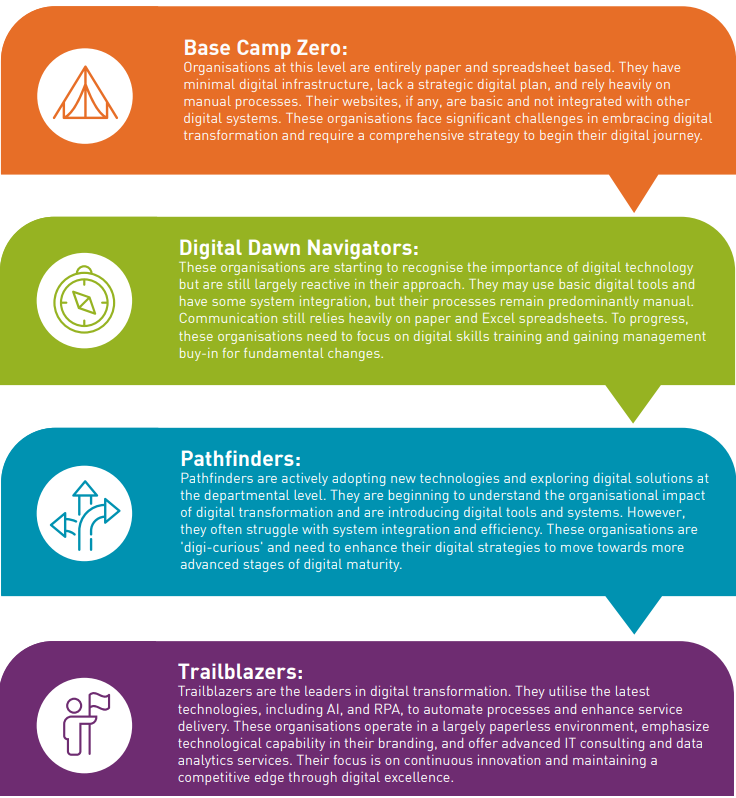
All AGN members are somewhere on the journey to Digital Transformation. The AGN Digital Maturity Diagnostic Tool (accessible to members only) provides AGN members with a diagnostic report and suggestions on key areas of improvement after answering a series of questions. The graphic below presents the four levels.
Practical Actions for AGN Members: What To Do Now
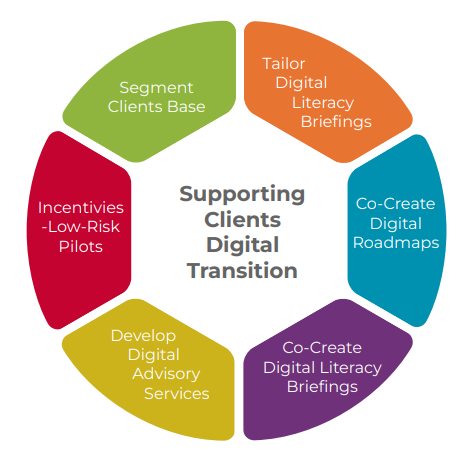
Here are 7 practical and immediately actionable steps AGN members can take to address client
digital immaturity.
1. Diagnose Your Client Base
Not all clients are equal in digital terms. Conduct a light-touch assessment of your top 50 clients and
classify them into tiers:
- Leaders – already using integrated cloud accounting and open to new tech.
- Followers – some adoption but inconsistent practices.
- Laggards – little to no use of digital tools.
Understanding this segmentation helps you prioritise efforts and tailor approaches.
2. Tailor Communications to Digital Maturity
Generic client emails or newsletters may miss the mark. Consider developing communications that speak
directly to the client’s digital level. For example:
- For ‘laggards’ – “Three simple tech steps that will reduce your admin burden.”
- For ‘leaders’ – “Harnessing AI for real-time business decision-making.
Understanding this segmentation helps you prioritise efforts and tailor approaches.
3. Launch Digital Literacy Briefings
Some clients simply don’t understand the ‘why’ of digital transformation. Host informal webinars,
breakfast briefings, or 1:1 sessions to:
- Demystify terms like AI, automation, and APIs.
- Demonstrate tangible value—like faster response times, better cash flow reporting, or automated
reconciliations. - Use simple, real-life client success stories.
This is education without the jargon.
4. Co-Create Digital Roadmaps
Engage your clients in developing their own digital journey. Help them define where they are now, where
they want to be in 12–24 months, and what steps they’ll take to get there. Consider offering these as part
of an onboarding pack, client review, or even as a chargeable advisory product.
Include milestones like:
- Migrate to cloud accounting.
- Implement client portal.
- Introduce simple dashboard reporting.
5. Develop Digital-First Advisory Services
Package services that are not only digitally delivered, but enhanced by digital capability. Examples:
- “CFO Dashboard-as-a-Service” – combining real-time reporting and monthly insights.
- “Cashflow Alerts & Predictive Modelling” – AI-generated forecasts and automated flags.
- “Digital Health Check” – one-time scan of client systems and readiness
These services exemplify your digital ability and offer clients tangible benefit. They can demonstrate to
laggards, what laggards are missing out on.
6. Upskill Relationship Managers to Spot & Sell Digital
Your partners and senior managers are often the closest to clients. Invest in training to help them. What
are the conversation starters? Do your partners/managers have a script around this topic? Are they
equipped with recommended solutions for those that show an interest?
Training might focus on:
- Recognising digital blockers (e.g., manual invoice processing).
- Introduce simple tools (e.g., Dext, Xero projects).
- Share short client stories that highlight transformation success.
7. Incentivise Change with Low-Risk Pilots
Offer time-limited discounts, bundled training, or “first 90 days free” options on new digital services.
This reduces the barrier to entry and lets clients experience the value before committing fully.
It’s about creating momentum and lowering risk—for both sides.
The Digital Acceleration Divide: What’s Going On?
AGN member firms are digitalising at an impressive pace. According to internal benchmarks and diagnostics, over 70% of firms have adopted some level of automation, AI experimentation, cloud systems integration, and dashboard reporting in the last 24 months.
They’re doing this not just to improve margins, but to:
- Increase delivery capacity without headcount.
- Elevate client insight and value.
- Create scalable advisory propositions.
However, client firms—particularly SMEs—are a mixed bag, and so these changes don’t alway get imdiate traction with clients.
Why Clients Are Lagging
Despite the steady advance of digital solutions within accountancy firms, many clients remain hesitant,
slow, or outright resistant to change. This hesitancy can be puzzling to firms that see the benefits so
clearly—but it is rooted in real, often deeply embedded challenges. Let’s explore the most common
causes:
Fear of Cost
Many SME clients see digital transformation as an expensive and potentially risky commitment.
Whether it’s the upfront investment in new software, the training costs for their team, or concerns about licensing and subscription models, clients often perceive digitisation as a luxury they cannot afford. There is also a lack of clarity around the return on investment (ROI). They ask, “Will this actually save me money or just complicate things further?”
Skill Gaps and Confidence Issues
Digital tools require new skills—not just technical knowledge, but also comfort in navigating platforms, interpreting data,
and making decisions based on digital insights. Many small business teams lack in-house tech-savvy staff. For older business owners or traditional sectors (e.g., agriculture, manufacturing), digital
language feels foreign. This lack of confidence results in avoidance.
Change Fatigue
The past five years have been particularly turbulent. COVID-19, supply chain disruptions, hybrid work adaptation, economic volatility, and regulatory shifts have already stretched the adaptive capacity of many SMEs. As a result, digital transformation often drops to the bottom of the priority list—perceived as “another initiative” they simply don’t have the bandwidth for.
No Burning Platform
In many cases, clients simply don’t see the urgency. Their current systems—however inefficient—still function. The absence of a major problem (e.g., a compliance
breach, cyberattack, or missed
opportunity) means there is little
impetus to act. The logic goes: “If it’s not broken, why fix it?”
Fear of Losing Control
Clients often feel they will lose oversight if too much is automated or digitised. Many owner/managers have built their companies on hands-on involvement, and the idea of
systems making decisions or exposing real-time data to others can feel threatening.
Previous Bad Experiences
Some clients have had poor experiences with digital tools in the past—software that was clunky, training that was
insufficient, or consultants that
disappeared once the invoice was paid. These stories linger and shape future resistance
The consequences for AGN firms are significant. As clients hesitate or stall, the firm’s ability to fully leverage its own digital infrastructure becomes compromised. And more than that—relationships begin to strain, as client expectations and firm capabilities move out of sync.
The Three Core Challenges of Client Digital Immaturity
Capability vs Comfort: A Growing Mismatch
AGN firms are increasingly fluent in digital working. From automated data extraction in audit engagements to predictive analytics in advisory, these capabilities are now embedded in many firms’ delivery models. However, when clients remain rooted in paper-based systems or low-tech workflows, the resulting disconnect is stark.
Scenario: For example, a mid-sized accounting firm rolled out an AI-assisted tax reconciliation platform designed to reduce turnaround time by 60%. However, nearly a third of clients declined to use it, citing uncertainty about “AI accuracy” and a preference for their long-time spreadsheet system. The firm is left straddling two workflows—one advanced, one antiquated—undermining efficiency and morale. Firms must then manage the cognitive dissonance of operating at two speeds: high-performance digital with some clients, and analogue friction with others. The costs—both operational and emotional—are real.
2. Digital ROI Stalls Without Client Buy-In
Most AGN members have made significant investments in digitisation—through client portals, automated workflows, intelligent document management systems, and AI-assisted compliance. These investments are intended to increase profitability, scalability, and consistency. But crucially, they rely on client participation to deliver value.
Scenario: If only half your clients upload documents through the portal, the manual chasing begins again. If clients ignore task alerts or continue to send documents via email or post, the system breaks down. Exceptions multiply. Instead of automation freeing time, your staff spend it correcting or working around the exceptions.
This stalls ROI and creates a hidden cost burden—you pay twice: once for the digital infrastructure, and again for the manual work required when clients don’t engage with it.
Worse still, this client behaviour often goes unbilled, because firms feel awkward charging clients for inefficiencies
they themselves created.
3. Advisory Services Need Clean, Timely Data to Work
The growing advisory proposition of AGN members depends on data—good data, recent data, reliable data. Whether it’s offering scenario modelling, ESG reporting, cash flow forecasting, or strategic dashboards, the fuel for these services is accurate and timely input from the client. Without it, even the most sophisticated advisory offer falters.
Scenario: A firm develops a real-time KPI dashboard for a key client. It’s ready to go live. But the client only updates their ledgers once a quarter and refuses to automate bank feeds. The dashboard becomes a digital ornament—impressive, but ultimately unused.
The trust built through advisory work is undermined when insights are incomplete or out of date. And from the firm’s side, the advisory effort becomes unscalable when every project requires a manual workaround just to get basic client data.
Final Word on the Lag
Digital transformation is not just a technical project—it’s a behavioural and cultural shift. AGN firms may have the systems and the know-how, but unless clients can be brought into the ecosystem, that transformation will be incomplete. Addressing the lag is not about forcing clients forward—it’s about understanding the reasons behind their resistance, and finding empathetic, ways to help them take the next step. That’s the opportunity for AGN members: to become not just accounting firms with great tec—but true transformation partners for the clients they serve.
The Advisory Opportunity: Turn the Gap into Growth
While the mismatch presents challenges, it also unlocks one of the biggest growth opportunities for mid-sized firms: become your client’s digital transformation guide. This is advisory with a capital A—and it’s exactly the journey AGN’s Advisory Migration Methodology (AMM) supports. The four regions of the AGN Advisory Migration Methodology (Data & Skills Inputs, Service Framework, Stakeholder Environment, and Outputs & Reporting) can be directly applied to assisting a mutual shift towards digital transformation and post digital advisory. The fact is your firm already understands the levers of the methodology – the opportunity here is to apply them to yours and the client’s business.

Top Tips:
Use what the software can provide to improve Outputs & Reporting. Help a client design board-level easy to access and interpret dashboards.
Offer training sessions to teach Foundational Skills data analysis skills to your client’s finance team.
This not only supports your client—it differentiates your firm in an increasingly commoditised market.
Think carefully about the Stakeholder & Business Environment. Understand how to manage change resistance in the client team.
Conclusion: Mind the Gap—Then Close It
Digital transformation has shifted from optional to existential. Your firm may already be adopting
the tools, platforms, and thinking required to thrive in the new era—but your clients may not
be ready. This readiness gap is now a defining feature of modern professional service delivery.
Firms that fail to bring their clients along risk frustration, underutilised investments, and missed
revenue.
But those who embrace the opportunity to educate, support and lead clients into the digital
age will:
- Unlock deeper relationships.
- Build scalable advisory offerings.
- Future-proof their own value proposition.
Mini podcast
Tune into our mini podcast on Spotify for a quick summary of the key insights.
Copyright © 2025 AGN International Ltd. All rights reserved. No part of this publication may be reproduced, distributed, or transmitted by non-members without prior permission of AGN International Ltd.
The post The Pace of Digital Transformation vs Client Readiness appeared first on AGN International.
]]>The post Private Equity – A New Era for Accounting Firms appeared first on AGN International.
]]>Audio bite.
Private equity (PE) is fundamentally reshaping the accounting industry, offering growth, expansion, and competitive positioning, while introducing complex strategic considerations for firms navigating this transformation.
On the move?
Tune into our mini podcast on Spotify at the end of this article for a quick summaryof the key insights.
So, are we seeing a New Era?
The traditional partnership model has long been the backbone of professional services. Definitions are unclear, but there are likely between 20 and 50 active PE-funded consolidators in each of the US and UK markets. Globally, the PE phenomenon is moving into other jurisdictions like Canada, Australia, and some other European and emerging markets.
This AGN Global Business Voice brings the thinking up-to-date and invites AGN members to think widely about their future options, identifying some “must-do now” actions.
Positioning For The New Era – What To Do Now
Evaluate Alternative Ownership Models
Firms should explore various ownership structures beyond full PE buyouts, such as hybrid models, Employee Stock Ownership Plans (ESOPs), or minority investor arrangements.
Drive Long-Term Growth and Modernisation
To remain competitive—whether pursuing PE investment or staying independent—firms must focus on sustainable growth strategies. This includes investing in digital transformation, strengthening talent acquisition & retention, and the evolution of their service offering in light of AI and technological impacts. It will be important to preserve and build an inclusive entrepreneurial culture.
Prepare for Regulatory and Structural Changes
As PE reshapes firm ownership, accounting firms must stay ahead of evolving regulations and industry oversight. Understanding compliance risks and governance changes will be critical for maintaining trust and credibility.
Assess Financial Risks, Including Debt Burden
PE-backed firms often take on significant debt through leveraged buyouts. Traditional firms should carefully analyse the financial implications of PE investment and ensure they do not compromise long-term stability for short-term gains.
Key Considerations for AGN Members
Traditionally, accounting firms have been structured as partnerships, offering long-term career paths culminating in equity ownership for high-performing professionals. The introduction of PE into the sector has begun to change this model.
- The pool of future firm owners may narrow, as equity is increasingly concentrated among institutional investors rather than senior professionals who have worked their way up through the firm.
- This could lead to talent retention challenges, as ambitious professionals may not have the equity participation opportunities they had expected.
- Some firms are exploring hybrid models that preserve elements of partnership structures alongside PE investment to maintain leadership incentives. Given the relaxed regulatory environment, there is scope here for imaginative solutions – Employee Stock Ownership Plans (ESOPs), Bank Funding etc, (See Appendix A).
- It will be important to build and maintain an inclusive and entrepreneurial culture, attractive to top professionals.
“The First Flip”: Still an Open Question
PE investment is cyclical, with firms typically undergoing a ‘flip’ to new investors after a few years. While the first wave of PE-backed firms in the accounting sector appears to be achieving initial return targets, it remains to be seen how sustainable these models will be over multiple investment cycles.
- The long-term value of PE-backed accounting firms will depend on their ability to generate sustained growth beyond the initial expansion phase.
- Investors will need to balance short-term financial targets with long-term client and talent retention strategies to avoid market instability.
- Close monitoring of the outcomes of early PE-backed firms will provide valuable insights into the sustainability of these investment models.
The Debt Burden Factor
One of the core mechanisms of PE investment is the use of leveraged buyouts (“LBOs”), where external funding is used to finance the acquisition of firms. While this approach can accelerate growth, it also introduces new financial risks:
- Some successful accounting firms that were previously self-sustaining are now carrying significant debt loads as a result of PE transactions.
- Is there a risk that this added financial burden may pressure firms to prioritise short-term Earnings Before Interest, Taxes, Depreciation, and Amortization (EBITDA) growth over long-term client service and professional development?
- Firms considering PE investment must carefully evaluate their ability to manage debt obligations while maintaining financial stability.
Evolving Markets, Talent & Technology
By bringing in top specialists and investment muscle, PE-funded businesses are leveraging technology and new expertise to drive efficiency, attract talented professionals, and provide great service and rewarding careers. We should anticipate notable successes as they drive high-quality, repeatable, and scalable approaches, such as technology driven auditing.
The PE phenomenon presents opportunities for conventionally funded firms: PE-backed firms’ technologies and expertise could become commercialised and more accessible, affordable, and common. Additionally, bespoke, high-touch, premium offerings like specialised tax services or sector-specific expertise may prefer other service models. Already, some conventionally funded firms are reporting an influx of recruits from the PE-backed environments — potentially the early stages of professionals opting for alternatives to professional life in the PE-backed models?
Regulatory Implications: Returns vs Quality?
The accounting sector has undergone a dramatic shift in ownership structures over the last 30 years, moving from unlimited liability partnerships of technical experts to corporate ownership of external investors. The latest shift catalysed by private equity has yet to be fully tested by regulatory bodies:
- Historically, partners bore direct responsibility for audit compliance and faced unlimited personal liability for their work. More recently, whilst most jurisdictions have had forms of limited liability for some time, ownership remained primarily with those working in the business.
- Under PE ownership, the legal and financial risk shifts further away from the individual professionals doing the work. At some point this may likely raise concerns about accountability.
- Regulatory responses remain uncertain, as audit oversight bodies adapt to a new landscape where ownership and compliance responsibilities are increasingly separated.
- The potential for future regulatory scrutiny is high, particularly as the sector grapples with maintaining audit integrity under a profit-driven ownership structure
Action for AGN Members
As firms navigate this evolving landscape, the key to success lies in strategic positioning
and informed decision-making. Firms should:
- Assess Long-Term Value Creation: Whether seeking PE investment or one of the alternative models, firms should focus on building a business that attracts investment while safeguarding long-term sustainability. Alongside, an emphasis on building an attractive entrepreneurial culture will be important.
- Remain Agile in Decision-Making: Whatever funding and ownership model is chosen for the future, PE will impact significantly the competitive landscape. Firms must actively evaluate the role that PE could play in their future, whether through a minority investment, full buyout, or strategic partnership.
- Understand the PE Investment Cycle: Firms should conduct rigorous due diligence on potential investors and ensure alignment between their long-term strategy and investor expectations.
- Monitor Regulatory Developments: Understanding how regulatory bodies respond to changes in firm ownership will be critical in ensuring compliance and maintaining public trust.
Essentially firms have an opportunity to pursue active modernisation and investment strategies – this attracts the PE community. And in more than the short term, whether with PE or other means, firms will need to adapt their strategies to remain competitive.
Conclusion: Embracing Change While Maintaining Integrity
Private equity represents neither a demolisher nor a panacea for accounting firms. But it undoubtedly represents a significant structural and competitive shift in the industry. If navigated effectively, it can drive both substantial growth and innovation, and significant opportunities for those choosing PE-backed models, or indeed the various alternative models that exist.
As AGN supports its members through these changes, we focus on equipping firms with insights and frameworks to thrive in this evolving landscape. PE is a transformative strategic tool that requires careful management. The choice for firms is not simply “PE or you lose”; rather, it is about how to adapt, grow, and create sustainable value while navigating the opportunities and challenges of PE investment where it is applied.
For further information on this topic or anything relating to the AGN International Association of Accounting and Advisory Firms or to become an AGN member, please email your closest AGN Regional Director (see below) or go directly to www.agn.org.
Malcolm Ward
CEO AGN International
mward@agn.org
Jean Xu
AP Regional Manager
jxu@agn.org
Marlijn Lawson
EMEA Regional Director
mlawson@agn.org
Cindy Frey CPA, CGMA
Americas Regional Director
cfrey@agn.org
Appendix 1: Other Ownership Models Are Available….
Employee Stock Ownership Plans (ESOPs)
- Employees acquire ownership over time, creating a vested interest in firm success.
- Potential tax advantages, including deferred capital gains tax for selling owners.
- Used successfully by accounting firms to maintain independence while offering succession
solutions.
Hybrid Partnership-PE Model
- Maintains a core group of equity partners while selling a minority stake to PE investors.
- Balances external capital for growth while retaining traditional partnership governance.
- Helps existing teams maintain control and cultural integrity.
Cooperative Ownership Model
- Shared ownership between employees, partners, and even clients or industry stakeholders.
- Encourages long-term decision-making and aligns incentives across all stakeholders.
- Rare but viable in professional services where sustainability and independence are priorities.
Strategic Alliances with Shared Ownership Pools
- Instead of full mergers, firms create equity pools across multiple firms.
- Used to create economies of scale, share tech investments, and enable joint market expansion.
- Could work well within international associations like AGN to build integrated service offerings
without ceding full PE control.
Minority Investor + Employee Option Pool
- External investors take a minority stake while employees get share options.
- Reduces challenge of cultural shift compared to full PE ownership.
- Provides liquidity while keeping leadership incentives aligned.
Public Listing via Alternative Investment Markets
- Some accountancy firms (e.g., in Australia and the UK) have explored IPOs or public listings on
secondary markets. - Offers access to capital while allowing the option of M&A with some element of consideration in
marketable securities. - Creates complexities in governance but can be a strong alternative for high-growth firms.
Private Family Office “Evergreen” Investment Model
- Allows firms to remain independent while securing funds for development.
- Long-term capital investment from a family office instead of PE firms.
- More patient capital, focused on steady growth rather than fast exits.
On the move?
Tune into our mini podcast on Spotify for a quick summary of the key insights.
Copyright © 2025 AGN International Ltd. All rights reserved. No part of this publication may be reproduced, distributed, or transmitted by non-members without prior permission of AGN International Ltd.
The post Private Equity – A New Era for Accounting Firms appeared first on AGN International.
]]>The post The Future of Accounting – Insights from AGN NextGenners appeared first on AGN International.
]]>Audio bite.
Our latest edition of Global Business Voice, The Future of Accounting, explores insights from the winning entry of the AGN 2024 ‘Road to Rome’ NextGen Challenge—AGN International’s flagship global competition aimed at fostering strategic thinking, collaboration, and innovation among early-career professionals.
On the move?
Tune into our mini podcast on Spotify at the end of this article for a quick summaryof the key insights.
How NextGenners Envision the Future of AI in Accounting

Among seven teams, each comprised of three individuals from AGN member firms across different countries, Team 5 emerged victorious. Their work showcased a visionary, practical, and deeply insightful approach to AI and digital transformation in accounting, setting a compelling benchmark for how future professionals will shape the industry.
Their two winning submissions tackled the profound implications of automation and AI in auditing, finance, and advisory services. Their thought leadership was not only forward-looking but also structured in a way that accounting firms can adopt to future-proof their workforce, service offerings, and ethical considerations.
A Vision for the Future — and the Strategic Shifts Required
The Road to Rome challenge is more than just an academic exercise. It is a window into how the next generation of accountants sees the profession evolving. The NextGenners’ vision of the future suggests that accountancy firms must make deliberate, strategic shifts:
1. From Compliance to AI-Driven Advisory: The future accountant will not be a compliance officer but a strategic AI-powered consultant. AGN support members journey to advisory with the following detailed guides and resources: AGN Migration Methodology related materials and AGN Advisory Resource Center
2. From Data Entry to Data Interpretation: AI will handle financial processing, while accountants must master advanced data analytics to deliver real insights.
3. From Traditional Risk Assessment to Real-Time Cybersecurity & AI Ethics: AI will flag financial risks in real time, but human professionals must ensure regulatory compliance and ethical AI decision-making.
Challenge 1: AI and Automation – The Future of Accounting Jobs
The first challenge asked teams to explore how AI and automation will redefine the accounting profession by 2030. Team 5 took an analytical approach, identifying a fundamental shift: the automation of routine accounting tasks will create new, higher-value roles focused on oversight, cybersecurity, advisory services, and AI governance.
Their research highlighted key transformations:
- Tasks Replaced: AI will handle risk assessment, financial report generation, audit report writing,
document summarisation, reconciliations, and real-time anomaly detection. - Tasks Added: A surge in demand for AI oversight, cybersecurity, advanced data analysis, AI-driven
client advisory, and compliance monitoring. - The New Audit Senior Manager: The traditional audit manager role will evolve into a hybrid AI expert and strategic consultant, requiring skills in AI oversight, cybersecurity, regulatory compliance, and relationship management.
Team 5 went a step further, crafting a job description for the Audit Senior Manager of 2030. They forecasted a blend of technology expertise, strategic advisory, and AI-enhanced decision-making as core competencies, rather than simply auditing financial statements.
What Can Member Firms Learn?
Reframe Staff Development:
AI training is no longer optional. Staff should be trained not just in how to use AI but in how to govern AI systems, ensure compliance, and interpret AI-driven insights.
Prepare for New Advisory Roles:
As AI takes over traditional compliance tasks, firms must pivot their staff towards value-added advisory services such as predictive analytics, business strategy, and AI consulting.
Balance Technology with Ethics:
AI bias, data privacy, and cybersecurity risks must be at the forefront of AI implementation in accountancy firms.
Team 5 – The Changing Roles in the AI Age – Audit Senior
| Category | Tasks Replaced (By AI & Automation) | Tasks Added (For Human Professionals) |
|---|---|---|
| Audit & Financial Reporting | Audit Risk Assessment using AI tools to develop audit programs & checklists | AI Oversight: Monitoring and reviewing automation tools & AI-generated outputs |
| Audit & Financial Reporting | Financial Report Generation with AI-generated reports & schedules | Advanced Data Analysis: Interpreting AI-generated financial insights |
| Audit & Financial Reporting | Audit Report Writing & Management Presentations automated by AI | AI Training & Governance: Training staff & clients on AI integration |
| Audit & Financial Reporting | Summarisation of Key Documents: AI to process annual reports, board minutes, and financials | Cybersecurity Management: Preventing & mitigating cyber threats |
| Compliance & Risk Management | Real-Time Review of Transactions to detect anomalies & flag risks | Ethical AI Governance: Ensuring AI-driven decisions comply with ethical & regulatory standards |
| Compliance & Risk Management | Automated Reconciliations & identification of non-reconciling items | Client Relationship Management: Customizing AI tools to fit client needs |
| Client & Staff Communications | Chatbot Assistance for general accounting inquiries | Client Advisory Services: Using AI-generated insights for strategic recommendations |
Challenge 2: Future-Ready Leadership – A Learning & Development Roadmap for AI in Auditing
Team 5’s second challenge focused on the practical side of AI adoption: how should firms train their workforce to thrive in an AI-driven accounting environment? Their response was a comprehensive Learning & Development (L&D) Program for Future Audit Managers, structured around five critical pillars:
01. AI Systems Management
– Introduction to AI-powered auditing tools used by firm
– Managing automated data entry and financial report generation tools
– Customization of AI systems specific to firm and client needs
Key Skill: AI Software Expertise
02. Cybersecurity
– Cybersecurity threats in financial systems
– Strategies to detect and prevent cyber attacks
– Mitigation plan in case of data breaches
Key Skill: Risk Mitigation
03. Governance: Ethical and Regulatory
– Industry-wide regulatory & compliance requirements
– How to avoid algorithmic bias and ensure transparency
Key Skill: Compliance Management
04. Develop as a Client Advisor
– Provide AI-augmented advisory services
– Customizing AI-generated forecasts for individual client need
Key Skill: Relationship Development
05. Collaboration
– How to effectively lead hybrid human-AI teams
– How to foster a culture of innovation and continuous improvement
Key Skill: Project management
Lessons for Accounting Firms: How to Stay Competitive in an AI World
Embed AI Training in L&D Programs:
A structured AI curriculum should be a mandatory part of upskilling
staff, mirroring the approach of Team 5’s roadmap.
Combine AI with Client Advisory:
AI is not just an efficiency tool; it’s a competitive advantage that firms can leverage to provide tailored financial strategies for
clients.
Position AI as an Employer Brand Asset:
Firms that demonstrate AI leadership attract top talent. The
firms that invest in AI-powered learning and career growth will become the employer of choice.
Final Thought: The Road to the Future is AI-Powered
Team 5’s Road to Rome victory is more than an award—it is a clear call to action for AGN firms worldwide. Their insights provide a blueprint for how firms should adapt to digital transformation, ensure their staff remain relevant, and deliver cutting-edge advisory services in an AI-first world.
For AGN firms that wish to remain ahead of the curve, the time to act is now. AI is not a distant future—it is here. And if firms don’t seize the opportunity to train their staff, reimagine advisory services, and embed AI into their operations, they risk being left behind.
Next Steps: How AGN Firms Can Adapt
- Adopt a structured AI training framework, similar to Team 5’s L&D proposal.
- Invest in AI-powered auditing and advisory tools, ensuring staff can leverage them effectively.
- Reassess service offerings—AI-powered cybersecurity, digital compliance, and AI consultancy
should become core services. - Position AI expertise as part of the employer brand—Attract and retain talent by ensuring professionals see AI as a career accelerator, not a threat.
Team 5 may have won Road to Rome, but their challenge-winning insights should serve as a strategic playbook for every AGN firm looking to remain competitive in a rapidly evolving AI-driven world.
AGN Resources:
- The AGN Advisory Resource Centre
- GBV: Unleashing the Power of ChatGPT
- GBV: The AGN Advisory Migration Methodology
- GBV: Making Sense of Cryptocurrencies: Part #1
- GBV: Metaverse Part 1 – The real reality?
- GBV: Metaverse Part 2 – The business implications
On the move?
Tune into our mini podcast on Spotify for a quick summary of the key insights.
For further information on this topic or anything relating to the AGN International Association of Accounting and Advisory Firms or to become an AGN member, please email your closest AGN Regional Director (see below) or go directly to www.agn.org.
Malcolm Ward
CEO AGN International
mward@agn.org
Jean Xu
AP Regional Manager
jxu@agn.org
Marlijn Lawson
EMEA Regional Director
mlawson@agn.org
Cindy Frey CPA, CGMA
Americas Regional Director
cfrey@agn.org
Copyright © 2025 AGN International Ltd. All rights reserved. No part of this publication may be reproduced, distributed, or transmitted by non-members without prior permission of AGN International Ltd.
The post The Future of Accounting – Insights from AGN NextGenners appeared first on AGN International.
]]>